

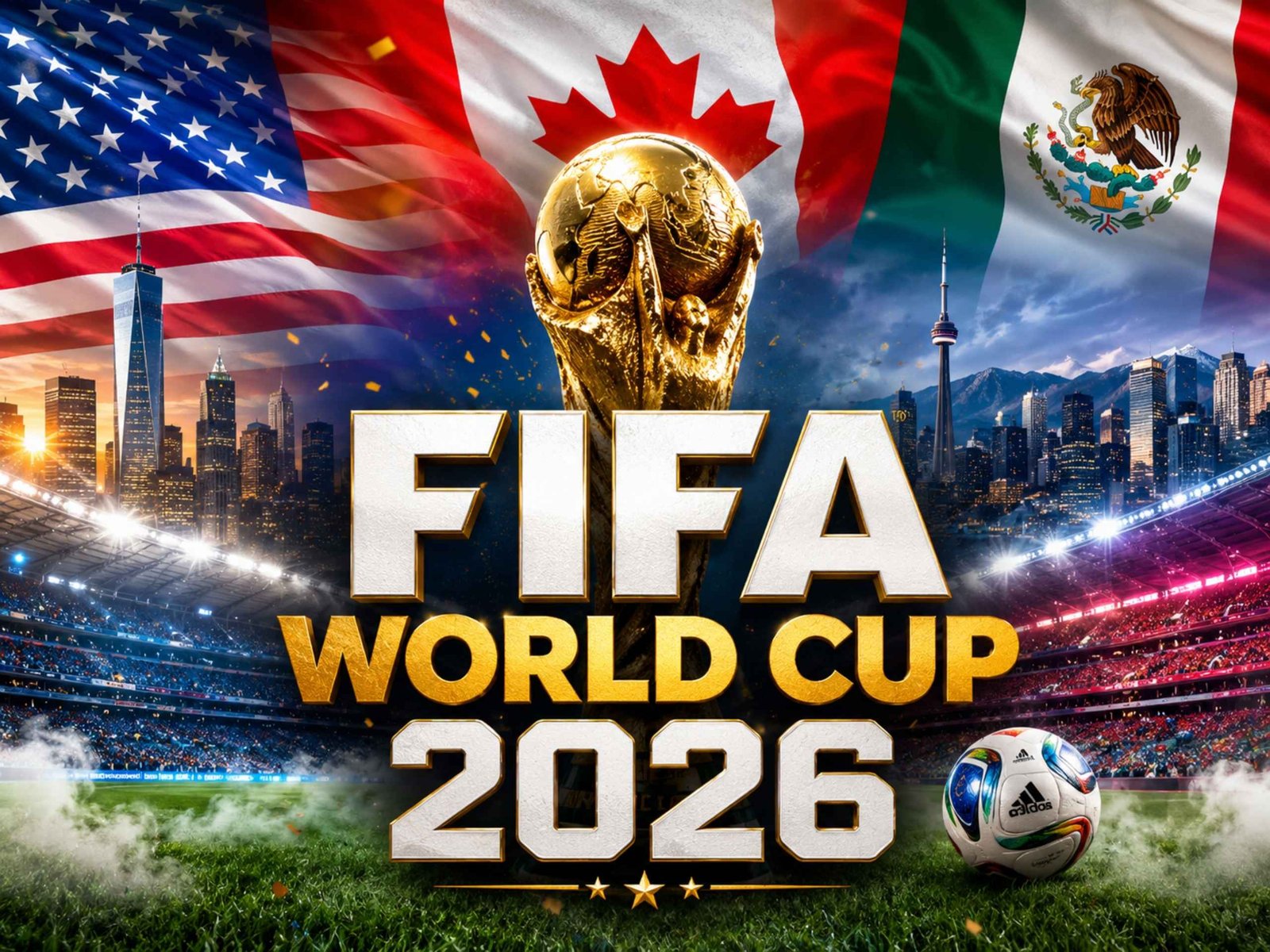
The FIFA World Cup 2026 will be the largest tournament in football history because it introduces an expanded 48-team format and a total of 104 matches. Hosted jointly by the United States, Canada, and Mexico from June 11 to July 19, 2026, the event offers unprecedented global participation and fan engagement.
Football fans around the globe mark their calendars in four-year cycles. Every tournament brings fresh drama, heart breaking exits, and moments of sheer brilliance that echo through history. However, the upcoming iteration of this beloved global event promises a scale and spectacle unlike anything the sport has ever witnessed. The FIFA World Cup 2026 represents a massive structural shift for international football.
For the first time, three distinct nations will share hosting duties, spreading the cultural footprint of the games across North America. This logistical marvel will test infrastructure, unite diverse fanbases, and highlight the growing prominence of football in the United States, Canada, and Mexico. Fans traveling to the tournament will experience three unique atmospheres, from the high-altitude intensity of Mexico City to the coastal energy of Vancouver and the bustling streets of New York.
By expanding the roster to 48 teams, FIFA has opened the door for emerging football nations to prove themselves on the ultimate stage. This post breaks down everything you need to know about the FIFA World Cup 2026 schedule, the host cities, the new format, and how you can prepare to secure your FIFA World Cup tickets 2026.
Table of Contents
What are the key details for the FIFA World Cup 2026 schedule and format?
The FIFA World Cup 2026 operates on a completely new scale. The tournament runs from June 11 to July 19, 2026, encompassing over a month of continuous sporting action. Historically, the World Cup featured 32 teams competing in 64 matches. The 2026 edition shatters that ceiling by inviting 48 teams to compete in a massive 104-match schedule.
This expanded framework means more football for viewers and significantly higher revenue for the governing bodies and host nations. The United States, Canada, and Mexico will act as the first-ever tri-nation hosting coalition. Organizing 104 matches across an entire continent requires precise logistical planning, and FIFA has strategically distributed the games across regions to minimize travel fatigue for the athletes. The final match will take place at MetLife Stadium in New Jersey on July 19, 2026, crowning the world champion in front of over 82,000 spectators.
Which host countries and cities will hold the FIFA 2026 matches?
The FIFA 2026 host cities span across North America, offering diverse travel experiences and football cultures. The United States will carry the heaviest load, hosting matches in major metropolitan hubs. Cities like New York/New Jersey, Los Angeles, Dallas, Miami, and Atlanta boast massive stadium capacities and extensive tourism infrastructure. American football culture has exploded in recent decades, and these cities have thriving domestic supporter groups ready to welcome international visitors.
Canada brings two vibrant cities into the mix: Toronto and Vancouver. Toronto’s BMO Field provides an intimate, incredibly loud environment, while Vancouver’s BC Place offers a stunning downtown stadium with a retractable roof. Canadian football has seen rapid growth, highlighted by the national team’s recent successes, making the Canadian host cities eager participants in the global festival.
Mexico brings the deepest historical pedigree to the tournament. Mexico City, Guadalajara, and Monterrey will host matches, marking Mexico’s third time hosting World Cup games (previously in 1970 and 1986). The Mexican travel experience offers fans rich culinary traditions and an unmatched passion for the sport. The iconic Estadio Azteca in Mexico City remains a temple of international football, guaranteed to provide a fierce and unforgettable atmosphere.
How does the new 48-team tournament format work for the 2026 World Cup?
The 2026 World Cup format radically changes how the group stages and knockout rounds operate. Instead of the traditional eight groups of four, the 48 qualified teams will be divided into 12 groups of four teams each. This ensures that every participating nation plays at least three matches, preserving the traditional group-stage excitement.
Under the new qualification rules, the top two teams from each of the 12 groups automatically advance. To fill out the newly introduced Round of 32, the eight best third-place teams will also progress. This system prevents early dead-rubber matches, as teams will fight until the final whistle of the third group game to secure one of those crucial third-place advancement slots.
FIFA changed the format primarily to encourage more global participation. For decades, highly competitive regions like Africa and Asia had limited qualification spots relative to their total member associations. The 48-team model provides more equitable access, allowing emerging football programs to test themselves against established European and South American giants. Consequently, this shift generates more matches, higher broadcasting revenues, and deeper global fan engagement.
Which major teams and new nations will qualify for the 2026 World Cup?
While the qualification cycles are still ongoing, several major teams remain clear favorites to feature prominently. Traditional powerhouses like Argentina, Brazil, France, England, and Germany consistently produce world-class talent and are expected to dominate their respective qualification zones. Japan also continues to establish itself as a formidable international competitor, combining technical precision with relentless work rates.
The true magic of the World Cup 2026 teams lies in the potential debutants. The expanded format drastically improves qualification odds for nations that usually narrowly miss out. Uzbekistan, Jordan, Curaçao, and Cape Verde are actively competing to make history by securing their first-ever World Cup appearances. Seeing these new nations line up for their national anthems will be a profound moment for their players and citizens.
Early predictions suggest that France and Argentina will remain title contenders due to their deep talent pools. However, dark horse teams like the United States, playing on home soil, or a rapidly improving African nation like Senegal or Morocco, could disrupt the established hierarchy and make deep runs into the knockout phases.
What is the match schedule and timeline for the 2026 FIFA World Cup?
The World Cup 2026 schedule demands endurance from both the players and the fans. The tournament timeline officially kicks off on June 11, 2026, with the opening match setting the tone for the group stage. The group stage will run relentlessly, featuring up to four matches per day to accommodate the 12 groups.
Once the group stage concludes, the knockout rounds begin with the newly instituted Round of 32. This additional knockout phase means a team must win eight matches to lift the trophy, compared to seven in previous tournaments.
The Round of 16, Quarterfinals, and Semifinals will follow in rapid succession throughout early to mid-July. The third-place play-off will take place on July 18, leading up to the grand Final on July 19, 2026. Fans mapping out their travel should pay close attention to the regional clustering of matches, as FIFA aims to keep specific groups playing within distinct geographic zones to cut down on exhausting cross-continent flights.
What makes the FIFA 2026 stadiums and venues so special?
The FIFA 2026 stadiums represent the pinnacle of modern sports engineering and historical legacy. MetLife Stadium in New Jersey, chosen for the prestigious final match, boasts a seating capacity exceeding 82,000. It offers state-of-the-art facilities and sits in the heart of one of the world’s most accessible media markets.
In Mexico City, the Estadio Azteca holds unparalleled historical importance. It is the only stadium to have hosted two previous World Cup finals, witnessing legendary performances by Pelé in 1970 and Diego Maradona in 1986. The stadium is undergoing modernization but retains its intimidating, cavernous atmosphere.
SoFi Stadium in Los Angeles and AT&T Stadium in Dallas highlight the extreme technological advancements of modern American venues. SoFi Stadium features an incredible double-sided 4K video board and a sweeping architectural canopy, while AT&T Stadium is famous for its colossal capacity (expandable to over 100,000) and luxurious fan amenities. These venues guarantee that the physical environment of the matches will be as spectacular as the football itself.
For football fans still debating the GOAT conversation, this detailed comparison of Ronaldo vs Messi – Who Is Best? breaks down their stats, trophies, records, and overall legacy in modern football.
What do we know about the official match ball, mascots, and anthem for 2026?
FIFA tournaments always feature distinct branding that reflects the host nations’ cultures. The official match ball for 2026 is rumored to be the Adidas Trionda. The meaning behind the design reportedly honors the tri-nation hosting agreement, blending indigenous artistic motifs from Mexico, Canada, and the United States with cutting-edge aerodynamic technology.
Official mascots play a huge role in merchandising and fan engagement. While official reveals are tightly guarded, expectations point toward a trio of mascots representing the distinct wildlife or cultural folklore of the Canada mascot, Mexico mascot, and USA mascot.
Music also defines the World Cup experience. The official anthem dictates the summer’s soundtrack, and industry insiders suggest a high-energy collaboration between global superstars Shakira and Burna Boy. Such a collaboration would bridge Latin, Afrobeat, and Western pop demographics, perfectly mirroring the global inclusivity of the tournament.
How can fans buy FIFA World Cup tickets 2026 and prepare for travel?
Securing FIFA World Cup tickets 2026 requires patience and strategic planning. Fans must register exclusively through the FIFA official website to access the ticket portal. Tickets are typically released in phased rollouts, starting with a random selection draw for early applicants, followed by first-come, first-served phases closer to the tournament dates.
Travel preparation should begin immediately after securing tickets. Visitors crossing borders between the USA, Canada, and Mexico must research visa preparation well in advance, as customs processing times can be lengthy.
Transportation within the continent relies heavily on domestic flights, though specific regional clusters (like the US Northeast or the Pacific Northwest) offer viable train or bus alternatives. Accommodation advice is simple: book early. Hotels and short-term rentals in major host cities will experience unprecedented demand. To mitigate costs, fans should consider staying in suburban areas connected to the stadiums via robust public transit networks. Furthermore, host cities will organize massive Fan Festivals and public viewing events, ensuring those without stadium tickets can still soak in the festival atmosphere safely and joyfully.
What new technology and rule changes will debut at the 2026 World Cup?
Football technology evolves rapidly, and the 2026 tournament will deploy advanced systems to ensure fair play. The implementation of VAR (Video Assistant Referee) will be smoother and faster. FIFA is introducing enhanced Smart Ball Technology featuring an internal motion sensor ball. This sensor tracks positional data hundreds of times per second, relaying instant information to the officiating crew to determine tight offside calls and out-of-bounds decisions with absolute certainty.
Rule changes are also on the horizon to protect player welfare during the gruelling 104-match schedule. New yellow card rules and suspension system updates are being reviewed by FIFA. The goal is to ensure that minor infractions do not disproportionately punish teams navigating the longer tournament format, potentially resetting yellow card accumulations slightly later in the knockout phases to guarantee that the world’s best players are available for the most critical matches.
Why will the FIFA World Cup USA Canada Mexico be a historic milestone?
The FIFA World Cup USA Canada Mexico represents a paradigm shift for international sports. The main reasons for its historic status are undeniable: it is the biggest World Cup ever, it features the most matches in tournament history, and it executes a highly complex first tri-nation hosting strategy.
Beyond the statistics, the tournament provides more opportunities for smaller football nations to experience the economic and cultural boost of a World Cup appearance. The impact on global football will be felt for generations. The growth of football in North America will accelerate, converting casual observers into lifelong domestic supporters, while the increased worldwide audience will generate record-breaking broadcasting engagement.
What are the next steps for fans anticipating the 2026 tournament?
The FIFA World Cup 2026 promises unparalleled scale, drama, and cultural celebration. With an expanded 48-team roster, 104 intense matches, and a vast geographical canvas across three incredible host nations, this event will dominate the global conversation throughout the summer of 2026.
If you plan to attend, now is the time to start saving, researching visa requirements, and monitoring the FIFA official website for ticket phase announcements. Whether you are traveling to cheer on a perennial champion or supporting a nation making its historic debut, preparing early is the best way to ensure you don’t miss out on football’s biggest global event.
Frequently Asked Questions (FAQ)
Where will FIFA World Cup 2026 be held?
The FIFA World Cup 2026 will be held across three North American countries: the United States, Canada, and Mexico. Matches will take place in 16 major host cities distributed throughout these nations.
How many teams will play in World Cup 2026?
The 2026 World Cup will feature 48 international teams. This is a significant increase from the previous 32-team format used in past tournaments.
When does FIFA World Cup 2026 start?
The tournament officially begins on June 11, 2026. It will run for over a month, concluding with the final match on July 19, 2026.
Which stadium will host the final?
The final match of the 2026 World Cup will be hosted at MetLife Stadium in East Rutherford, New Jersey (part of the New York metropolitan area).
How does the new 48-team format work?
The 48 teams are divided into 12 groups of four. The top two teams from each group, along with the eight best third-place teams, will advance to a newly created Round of 32 knockout stage.

