

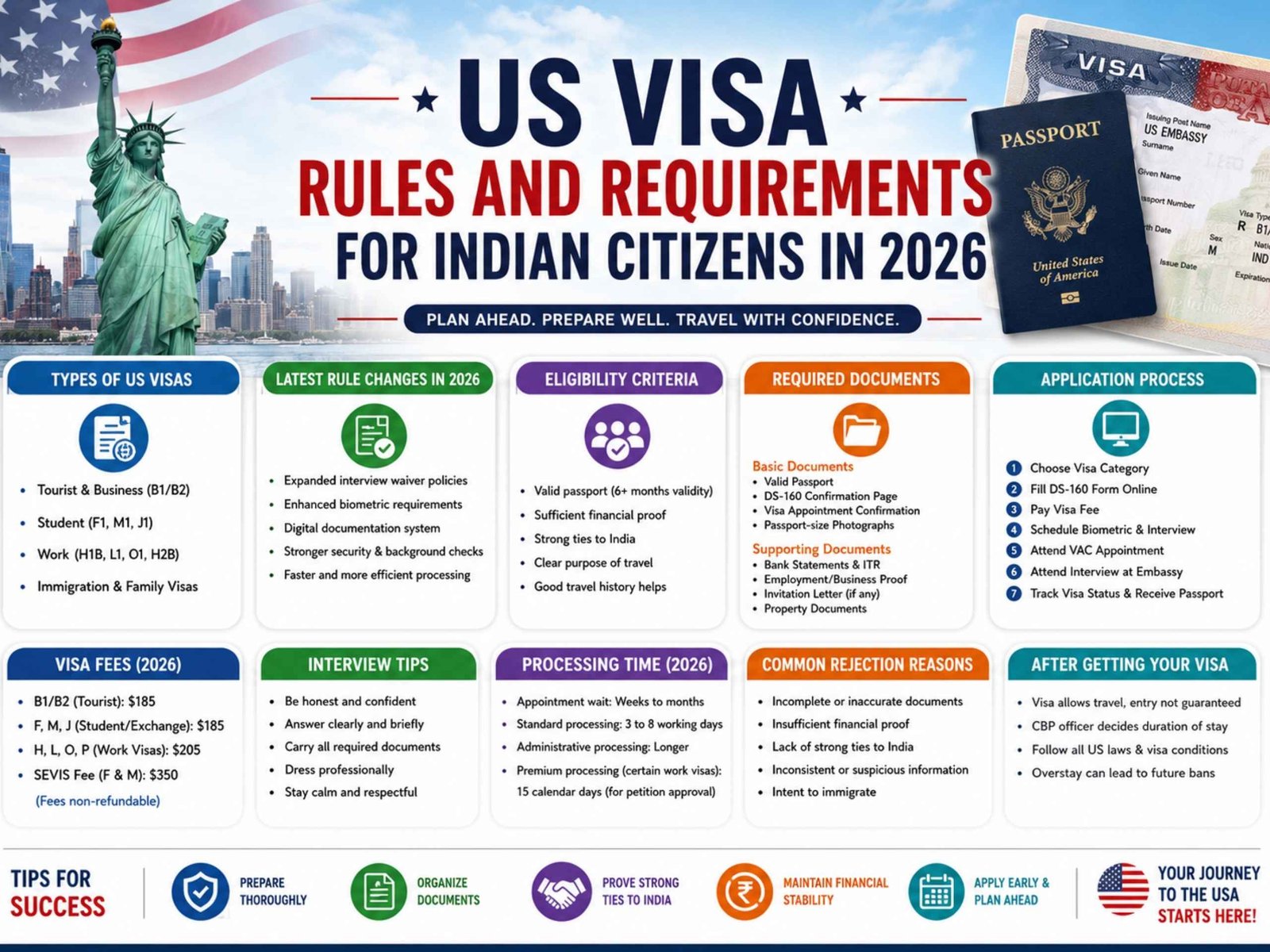
The US visa process for Indian citizens in 2026 involves updated digital documentation, expanded interview waiver policies, and new biometric requirements. Applicants must submit the DS-160 form, pay the relevant visa fees, and provide robust financial and employment documentation to secure tourist, student, or work visas successfully.
Travel demand from India to the United States continues to surge. Thousands of students, IT professionals, tourists, and families plan cross-continental trips every single day. Understanding the exact requirements set by the US Department of State and the latest US Visa Rules is crucial for a successful application. A single missing document or misunderstood policy can lead to extensive delays or outright rejections.
The year 2026 introduces several important updates designed to streamline processing times and enhance border security. The US consulate has shifted heavily toward digital documentation systems and updated interview waiver criteria. These modifications directly impact how quickly Indian applicants can secure an appointment and receive their stamped passports.
This comprehensive guide breaks down everything Indian citizens need to know about the current US visa landscape. You will learn about specific eligibility criteria, fee structures, processing timelines, and actionable strategies to maximize your chances of approval under the 2026 regulatory framework.
Table of Contents
What are the types of US visas available for Indian citizens in 2026?
The US immigration system divides visas into distinct categories based on your primary purpose of travel. Choosing the correct classification is the foundational step of your application.
Tourist and Business Visas
The B-category visas serve individuals entering the United States temporarily for business or pleasure.
- B1 Visa: Designed specifically for business consultations, attending scientific or educational conventions, or negotiating contracts.
- B2 Visa: Issued for tourism, visiting friends and relatives, or receiving medical treatment.
- Combined B1/B2 Visa: The most common visitor visa issued to Indian applicants, allowing flexibility for both business meetings and leisure activities during the same trip.
Student Visas
Indian students represent one of the largest international academic populations in the US.
- F1 Visa: Required for students attending an accredited US college, university, or academic high school.
- M1 Visa: Designed for students engaging in non-academic or vocational studies.
- J1 Exchange Visitor Visa: Issued to individuals participating in approved exchange programs, including research scholars, professors, and cultural exchange participants.
Work Visas
Professionals seeking employment in the US must secure a specialized work visa sponsored by a US employer.
- H1B Visa: The highly sought-after visa for workers in specialty occupations requiring highly specialized knowledge and at least a bachelor’s degree.
- L1 Visa: Used for intracompany transferees. This allows multinational companies to transfer executives, managers, or specialized knowledge employees from an Indian office to a US office.
- O1 Visa: Reserved for individuals possessing extraordinary ability in sciences, arts, education, business, or athletics.
- H2B Visa: Available for temporary or seasonal non-agricultural workers.
Immigration and Family Visas
For those intending to live in the United States permanently, immigrant visas are necessary.
- Green Card categories: Employment-based permanent residency paths allow highly skilled Indian professionals to settle in the US.
- Family sponsorship visas: US citizens and lawful permanent residents can sponsor their Indian spouses, parents, children, or siblings for immigration.
What are the latest US visa rule changes introduced in 2026?
The US Department of State continually refines its procedures. The 2026 updates focus on modernization and security.
- New interview waiver policies: The DropBox program (interview waiver) criteria have been updated. Many applicants renewing their visas within the same category face fewer in-person interview requirements, provided their previous visa expired recently.
- Updated biometric requirements: Security enhancements now require higher-resolution digital fingerprinting and advanced facial recognition data during the Visa Application Center (VAC) appointment.
- Digital documentation system: Consulates are shifting toward a paperless review process. Applicants must upload supporting documents to a centralized portal before their physical appointments.
- Changes in the visa appointment process: The scheduling portal now utilizes stricter anti-bot measures to ensure fair access to appointment slots for genuine applicants.
- New travel security checks: Enhanced background screening protocols are integrated into the DS-160 submission phase, occasionally extending the initial processing window.
- Processing time updates: Consular teams have optimized workflows to clear historical backlogs, standardizing processing times across major Indian metropolitan hubs.
Who is eligible for a US visa from India?
Consular officers evaluate every application against strict legal standards. Applicants must demonstrate strong ties to India to overcome the presumption of immigrant intent (under Section 214(b) of the Immigration and Nationality Act) for non-immigrant visas.
- Passport requirements: Your Indian passport must remain valid for at least six months beyond your intended period of stay in the United States.
- Financial proof requirements: You must possess sufficient funds to cover all expenses during your trip. This prevents travelers from becoming public charges or seeking unauthorized employment.
- Travel history importance: A history of compliance with previous international travel rules (like holding a Schengen or UK visa) strengthens your profile.
- Employment and income verification: Stable employment in India serves as a strong tie to your home country.
- Educational requirements for students: F1 applicants must hold an I-20 form from a SEVP-approved institution and demonstrate academic readiness.
- English language requirements: While not strictly mandatory for tourist visas, student and work visa applicants generally need sufficient English proficiency to function in their designated roles.
What documents are required for a US visa application?
Organizing your paperwork accurately prevents administrative delays and shows the consular officer that you are a credible applicant.
Basic Documents
Every non-immigrant applicant must present these foundational items:
- Valid passport: Current passport and any old passports containing previous US visas.
- DS-160 confirmation: The barcode confirmation page of your completed online application.
- Visa appointment confirmation: Proof of your scheduled interview and VAC appointments.
- Photographs: Recent 2×2 inch photographs meeting specific US Department of State sizing and lighting requirements.
Supporting Documents
Officers rarely ask to see every supporting document, but having them readily available is essential.
- Bank statements: Stamped statements from the past six months showing consistent balances.
- Income tax returns: ITR-V forms for the last three consecutive years.
- Employment letters: Leave approval letters, salary slips, and a No Objection Certificate (NOC) from your employer.
- Invitation letters: Letters from family members, friends, or business partners currently residing in the US.
- Property documents: Proof of real estate ownership in India, which serves as a strong home-country tie.
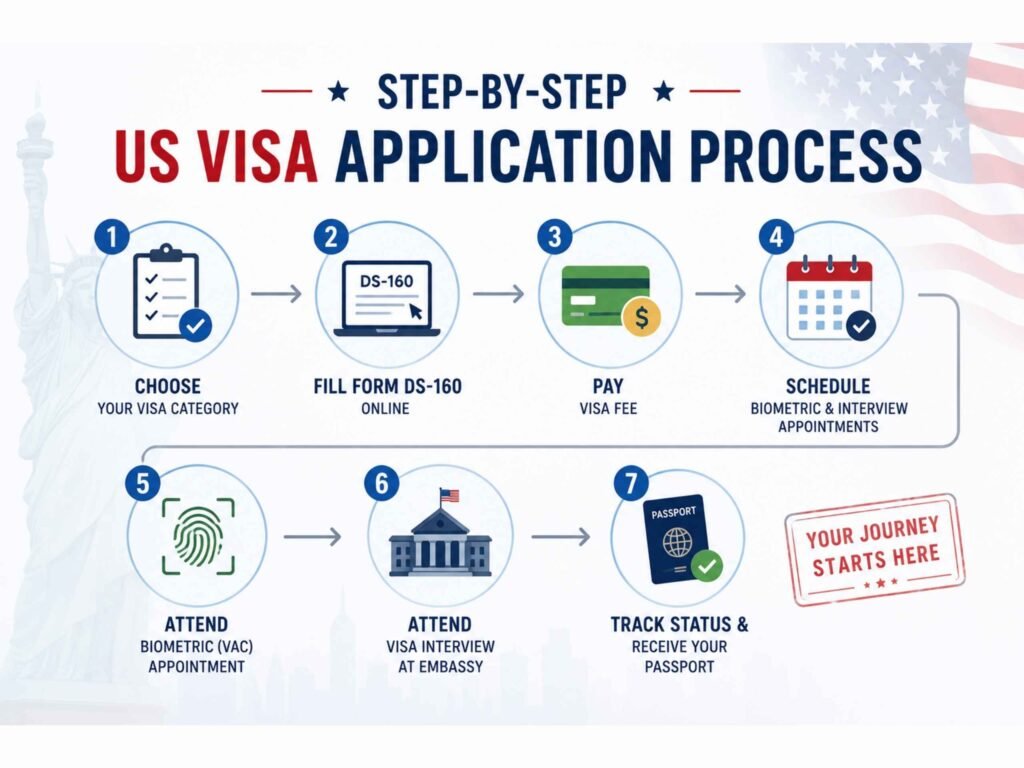
How do you complete the step-by-step US visa application process?
Securing a US visa requires a systematic approach. Follow these steps sequentially to ensure a smooth experience.
- Choose your visa category: Identify the visa class that strictly matches your purpose of travel.
- Fill the DS-160 form: Complete the online Nonimmigrant Visa Application accurately. Save your application ID immediately.
- Pay visa fees: Create an account on the US scheduling portal and pay the Machine Readable Visa (MRV) fee via NEFT, IMPS, or designated bank branches.
- Schedule biometrics and interview: Book two separate appointments. The first is for the VAC (biometrics), and the second is for the consular interview.
- Attend the VAC appointment: Visit the Visa Application Center to submit your fingerprints and photograph.
- Attend the embassy interview: Arrive at the US Embassy or Consulate for your scheduled interview with a consular officer.
- Track visa status: Use the CEAC (Consular Electronic Application Center) website to track your passport delivery status post-interview.
What are the US visa fees for Indian applicants in 2026?
Visa fees are non-refundable and must be paid before scheduling an appointment. Ensure you pay the exact amount based on the current exchange rate dictated by the consulate.
- Tourist visa fees: The standard B1/B2 visa application fee is highly regulated and typically set by the Department of State for non-petition-based nonimmigrant visas.
- Student visa fees: F, M, and J visas carry the standard non-petition application fee.
- Work visa fees: Petition-based visas (like H, L, O) incur a slightly higher MRV fee.
- SEVIS fees: Student and exchange visitors must pay a separate I-901 SEVIS fee directly to the Department of Homeland Security before their interview.
- Premium processing fees: Certain employment-based petitions filed by US employers with USCIS offer premium processing for an additional, substantial fee to expedite the initial petition approval.
- Payment methods in India: Acceptable payment methods include Electronic Funds Transfer (EFT), mobile payments (IMPS), or cash at designated Axis Bank or Citibank branches.
What are the best US visa interview tips for Indians?
The consular interview usually lasts less than five minutes. First impressions and concise communication dictate the outcome.
- Common interview questions: Expect questions regarding your purpose of travel, your financial sponsor, your current employment, and your intended duration of stay.
- How to answer confidently: Provide short, direct answers. Do not offer unsolicited information. If the officer asks a yes-or-no question, answer with a simple yes or no.
- Mistakes to avoid: Do not memorize rehearsed speeches. Avoid bringing fraudulent documents, as this results in a permanent ban from entering the US.
- Dress code tips: Wear professional or smart-casual attire. Dressing neatly demonstrates respect for the process.
- Required behavior: Maintain natural eye contact, listen carefully to the officer’s questions, and remain calm throughout the exchange.
How long is the US visa processing time in 2026?
Timelines fluctuate based on the season, application volume, and the specific consulate you choose.
- Average waiting times in India: Tourist visa appointment wait times can stretch over several months due to high demand, while student and temporary worker appointments are prioritized.
- Emergency appointment options: Applicants facing urgent medical crises, unexpected business emergencies, or imminent academic start dates can request an expedited appointment through the scheduling portal.
- Premium processing timelines: For H1B and L1 visas, US employers can utilize premium processing to have the underlying USCIS petition approved within 15 calendar days.
- Delays and backlog issues: Applications placed in administrative processing (Section 221(g)) require additional background checks, extending the final decision timeline by weeks or even months.
What are the main reasons for US visa rejection?
Understanding why officers deny visas helps you build a more resilient application.
- Incomplete documents: Failing to bring the DS-160 confirmation, an updated passport, or proper petition approvals.
- Weak financial proof: Inability to demonstrate how you will fund your trip, leading officers to suspect you might seek illegal employment.
- Lack of travel history: A blank passport can be a negative factor for tourist visa applicants, though it is not an automatic disqualifier.
- Suspicious information: Discrepancies between your DS-160 responses and your verbal answers during the interview.
- Immigration intent concerns: The inability to prove strong ties (family, property, stable job) forcing you to return to India after your authorized stay.
How can Indian applicants increase their US visa approval chances?
Proactive preparation separates successful applicants from denied ones. Choose transparency and preparation over shortcuts.
- Strong documentation: Ensure every claim made on your DS-160 is backed by a verifiable physical document in your folder.
- Honest application details: Never hide previous visa refusals or criminal records. Honesty builds trust with the adjudicating officer.
- Financial stability proof: Maintain healthy bank balances for several months prior to applying rather than depositing a large lump sum right before the interview.
- Clear travel purpose: Have a detailed, logical itinerary. Know exactly where you are staying and what you plan to do.
- Good interview preparation: Practice answering standard questions with a colleague or family member to reduce anxiety on the actual day.
Where are the US Embassy and Consulate locations in India?
India hosts one of the largest US diplomatic missions globally. You can schedule your interview at any of the following locations, regardless of your home state.
- New Delhi: The US Embassy is located in the Chanakyapuri diplomatic enclave.
- Mumbai: The Consulate General is situated in the Bandra Kurla Complex (BKC).
- Chennai: Located on Gemini Circle, processing a massive volume of student and IT worker visas.
- Hyderabad: The Consulate General in Nanakramguda primarily handles a large share of H1B and F1 applicants.
- Kolkata: The Consulate General on Ho Chi Minh Sarani serves applicants from eastern and northeastern India.
What are the travel rules after getting a US visa?
A stamped visa allows you to travel to a US port of entry, but it does not guarantee admission.
- Entry requirements at US airports: Customs and Border Protection (CBP) officers conduct a brief secondary interview upon arrival to verify your travel purpose.
- Customs and immigration process: You must declare specific agricultural products, large sums of currency, and comply with all import regulations.
- Duration of stay rules: The CBP officer determines how long you can stay. For B1/B2 visas, this is typically up to six months, recorded on your digital I-94 arrival/departure record.
- Visa extension rules: If circumstances change, you can apply for an extension of stay through USCIS before your authorized I-94 period expires. Overstaying even by a single day instantly voids your current visa.
For a complete guide on Japan visas, you can also read detailed resources on the Japan Work Visa process for Indian and explore the full Japan Work Visa requirements and application steps for better understanding.
FAQs about US Visa Rules
Can Indians get a US visa without an interview?
Yes, many Indian citizens qualify for the interview waiver (DropBox) program. Choose this option if you are renewing a visa in the same category that expired within the last 48 months, subject to current Department of State updates.
How long is a US tourist visa valid for Indian citizens?
A US B1/B2 tourist visa is typically issued to Indian passport holders with a validity of 10 years, allowing multiple entries. However, the maximum duration of a single stay is usually capped at six months by CBP.
Can Indian students work in the US on an F1 visa?
Yes, F1 students can work on-campus for up to 20 hours per week during the academic term. Off-campus employment requires specific authorization, such as Curricular Practical Training (CPT) or Optional Practical Training (OPT).
What happens after a US visa rejection?
If rejected under Section 214(b), you can reapply at any time. However, you must pay the application fee again and should ideally wait until your circumstances have significantly improved before submitting a new application.
How early should Indians apply for a US visa in 2026?
Due to high demand and fluctuating appointment availability, Indian citizens should apply at least three to six months before their intended travel date to ensure sufficient time for processing and potential delays.
Best strategies for a successful US visa application
Securing a US visa in 2026 requires meticulous attention to detail and a thorough understanding of the modernized application landscape. The digital updates and revised waiver rules offer a streamlined path for well-prepared travelers. By prioritizing honest documentation, demonstrating unshakeable ties to India, and thoroughly preparing for the consular interview, you position yourself for a positive outcome. Follow the guidelines outlined above, track the latest embassy announcements, and take the first step toward your travel goals with confidence.

