

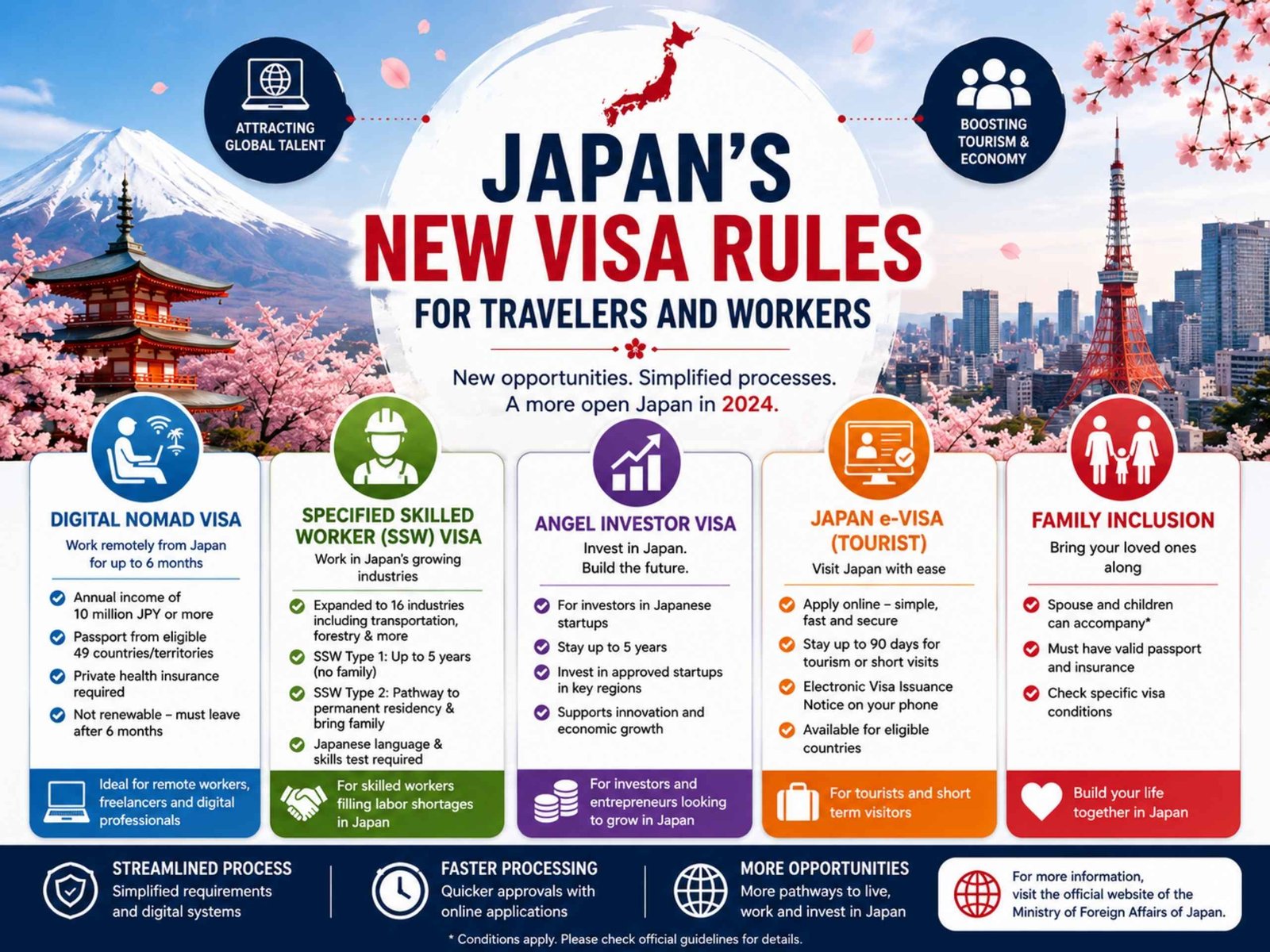
Japan introduced several new visa rules in 2026 to attract foreign talent and boost tourism. Key updates include a six-month Digital Nomad Visa for remote workers earning over 10 million JPY annually, an expanded Specified Skilled Worker (SSW) program addressing labor shortages, and a streamlined e-Visa system for short-term visitors.
Japan has historically maintained strict immigration policies, making long-term residency difficult for many foreign nationals. Recent demographic shifts have prompted the Japanese government to fundamentally rethink how the country attracts international talent. With an aging population and significant labor shortages across critical industries, Japan is opening its doors wider than before.
The introduction of new visa rules in Japan marks a significant policy shift aimed at revitalizing the national economy. Lawmakers have recognized that sustaining economic growth requires a steady influx of global professionals, remote workers, and tourists. By modernizing the visa framework, the Japanese government aims to position the country as a top destination for highly skilled international workers and digital nomads.
Navigating immigration law can feel overwhelming. This guide breaks down the most critical updates to Japan’s visa policies. You will learn the exact requirements for the newly launched Digital Nomad Visa, understand the expansions to the Specified Skilled Worker program, and discover how the electronic visa system simplifies short-term travel.
Table of Contents
What are the requirements for Japan’s Digital Nomad Visa?
The Japanese government officially launched the Digital Nomad Visa in late March 2026. This specific visa category allows remote workers, freelancers, and independent contractors to live and work in Japan for up to six months. Before this update, remote workers had to rely on standard 90-day tourist visas, which strictly prohibited engaging in any remunerated activities.
To qualify for Japan’s Digital Nomad Visa, applicants must meet several strict financial and legal criteria. First, the applicant must possess a passport from one of the 49 countries and territories that currently share a visa-exemption agreement with Japan. This list includes the United States, the United Kingdom, Australia, and most European Union member states.
Second, the financial threshold requires applicants to prove an annual income of at least 10 million Japanese Yen (JPY). Depending on currency exchange rates, this figure translates to roughly 65,000 to 70,000 United States Dollars. Applicants must provide tax returns, bank statements, or employment contracts to verify this income level.
Finally, digital nomads must secure comprehensive private health insurance for the entire duration of their stay. The Japanese Digital Nomad Visa does not grant access to Japan’s National Health Insurance system. Furthermore, this six-month visa cannot be renewed consecutively. Digital nomads must leave Japan upon the visa’s expiration and wait a mandatory six-month cooling-off period before reapplying for the same visa category.
How has the Specified Skilled Worker (SSW) visa changed?
Japan originally introduced the Specified Skilled Worker (SSW) visa in 2019 to combat severe labor shortages in foundational industries. In 2026, the Japanese government announced a major expansion of the SSW program, aiming to accept up to 820,000 foreign workers over the next five years. This target represents a massive increase from previous quotas.
The Specified Skilled Worker visa is divided into two distinct categories: Type 1 and Type 2. SSW Type 1 allows foreign nationals to work in Japan for up to five years but does not permit workers to bring family members. SSW Type 2 requires highly specialized skills, allows workers to bring their spouses and children, and provides a direct pathway to permanent residency in Japan.
The recent policy updates have expanded the industries eligible for the SSW program. The Japanese government added four new sectors to the approved list: road transportation, railways, forestry, and timber industries. Within the transportation sector, foreign workers can now secure employment as bus drivers, taxi drivers, and logistics truck drivers. These additions address a critical nationwide shortage of commercial drivers.
To qualify for the SSW visa, applicants must pass two major assessments. First, candidates must pass a Japanese language proficiency test to ensure they can communicate effectively in the workplace. Second, applicants must pass a technical skills exam specific to their chosen industry.
What is the new Angel Investor Visa in Japan?
Alongside programs for remote workers and laborers, Japan is actively targeting high-net-worth individuals and startup founders. The government has proposed a new Angel Investor Visa designed to inject foreign capital into Japanese startup ecosystems, particularly in designated strategic zones like Tokyo, Fukuoka, and Kyoto.
The Angel Investor Visa will allow venture capitalists and individual angel investors to reside in Japan for up to five years. To qualify, investors will likely need to demonstrate a history of successful startup funding and commit a significant amount of capital to Japanese enterprises. Local municipalities will oversee the vetting process to ensure the investments align with regional economic goals.
This initiative aims to solve a chronic lack of early-stage funding for Japanese tech startups. By bringing experienced foreign investors into the local market, Japan hopes to foster innovation and create globally competitive technology companies.
How does the new Japan e-Visa system work for tourists?
For short-term visitors, the application process has become entirely digital. The Ministry of Foreign Affairs launched the Japan e-Visa system to streamline entry for tourists and reduce the administrative burden on Japanese embassies worldwide.
The Japan e-Visa allows eligible foreign nationals to apply for a single-entry short-term stay visa online. This electronic visa grants tourists the ability to stay in Japan for up to 90 days for the purposes of leisure, visiting friends, or attending short business conferences.
Applicants must complete a digital form, upload a scan of their passport, provide a facial photograph, and submit proof of onward travel. Once approved, the traveler receives an electronic “Visa Issuance Notice” on their smartphone. Travelers must present this digital notice—not a screenshot or printout—by logging into the official portal at the immigration checkpoint.
Currently, the e-Visa is available to citizens of specific countries, including Brazil, India, Saudi Arabia, South Africa, and the United Arab Emirates, among others. Citizens of countries with existing visa-waiver agreements (such as the United States) do not need an e-Visa for short tourist visits.
Which Japan visa option is best for your specific situation?
Choosing the right immigration pathway depends entirely on your professional status, financial resources, and long-term goals. Use the following decision criteria to determine which of Japan’s new visa rules applies to your situation:
- Choose the Digital Nomad Visa if you are an established remote worker earning over 10 million JPY annually, and you want to experience living in Japan for up to six months without securing local employment.
- Choose the Specified Skilled Worker Visa if you possess specific vocational skills (such as nursing, construction, or transportation), you want to work directly for a Japanese company, and you are seeking long-term employment of up to five years.
- Choose the SSW Type 2 Visa if you are a highly specialized worker who eventually wants to apply for permanent residency in Japan and bring your immediate family with you.
- Choose the Japan e-Visa if you are a citizen of an eligible country, you do not qualify for a visa waiver, and you plan to visit Japan purely for tourism for under 90 days.
- Choose the Angel Investor Visa if you have significant capital, a track record of venture funding, and a desire to live in Japan while actively investing in local startups.
Navigating Your Next Steps for Relocating to Japan
Japan’s new visa rules represent a remarkable opportunity for global citizens. Whether you are a freelance software developer looking to spend six months in Kyoto, or a commercial driver seeking long-term employment in Tokyo, the pathways to living in Japan are more accessible than ever.
To take advantage of these updates, begin gathering your necessary documentation early. Digital nomads should prepare certified tax documents and source appropriate international health insurance. Prospective skilled workers should begin studying for the Japanese Language Proficiency Test (JLPT) and research the specific technical exams required for their industry. By understanding these new legal frameworks, you can smoothly transition your life and career to Japan.
Frequently Asked Questions About Japan’s Visa Updates
Can I bring my family to Japan on the Digital Nomad Visa?
Yes, the Japan Digital Nomad Visa allows applicants to bring their spouse and children. However, accompanying family members must also possess passports from visa-exempt countries and be covered by private medical insurance for the duration of the six-month stay.
Can I renew the Japanese Digital Nomad Visa?
No, the Japanese Digital Nomad Visa cannot be renewed consecutively. After the six-month visa expires, you must leave Japan. You can only apply for a new Digital Nomad Visa after waiting for a minimum of six months outside of the country.
How much does the Japan e-Visa cost?
The cost of the Japan e-Visa varies depending on the applicant’s nationality. The standard fee is approximately 3,000 JPY (around 20 USD), but some nationalities are exempt from visa fees entirely based on reciprocal agreements. Payments are processed securely through the online application portal.
Does the Specified Skilled Worker visa lead to permanent residency?
The SSW Type 1 visa does not lead to permanent residency. However, workers who upgrade to the SSW Type 2 visa—which requires passing advanced skills exams—can renew their visas indefinitely and eventually apply for Japanese permanent residency.
Do I need a sponsor for the Specified Skilled Worker visa?
Yes, you must have a confirmed job offer from a Japanese company or a registered support organization to apply for the Specified Skilled Worker visa. The employing company acts as your legal sponsor throughout your stay in Japan.

