

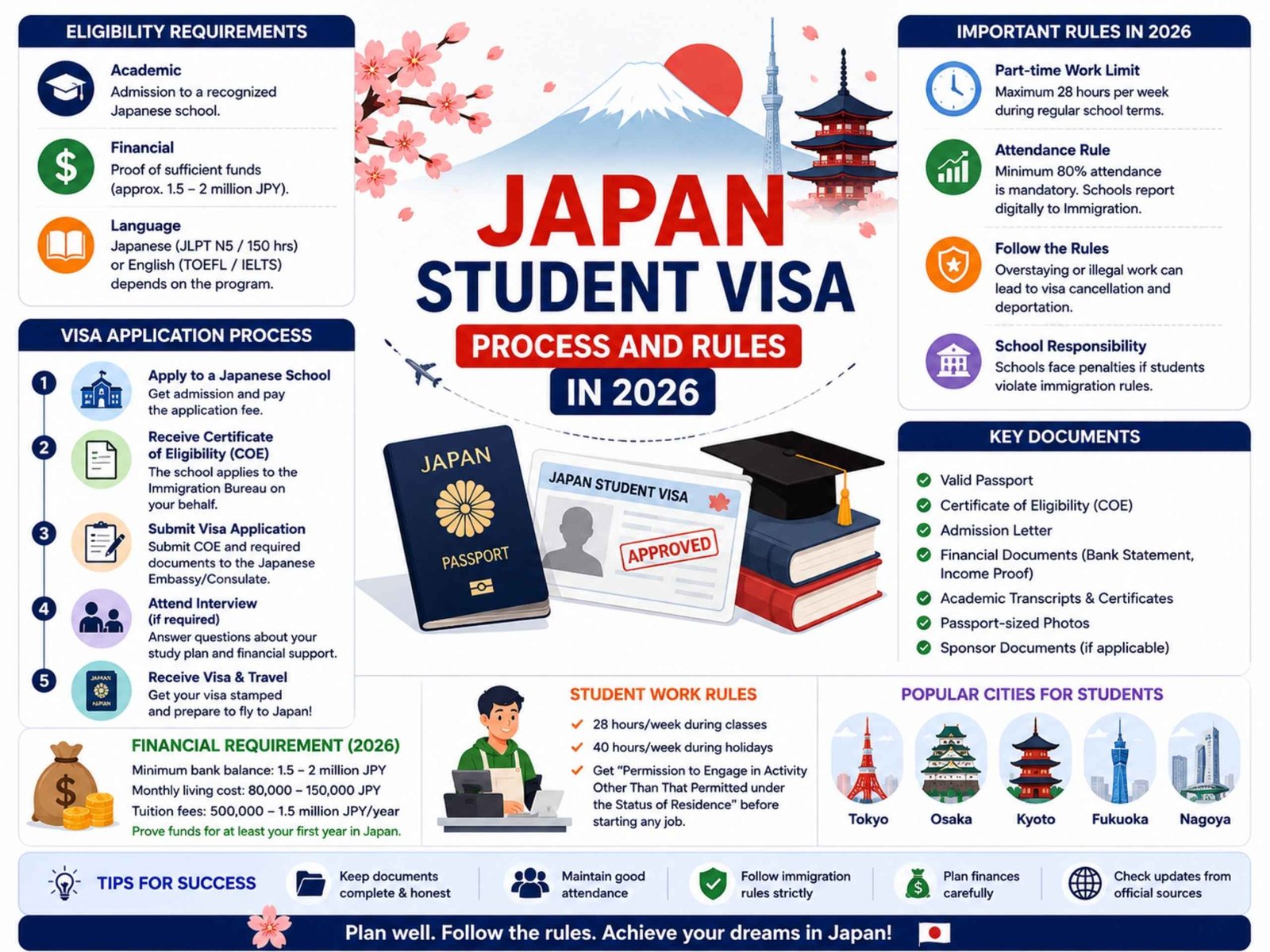
Quick answer: To get a Japan Student Visa in 2026, international students must secure a Certificate of Eligibility (COE) from a Japanese school, prove sufficient financial funds (typically around 1.5 to 2 million JPY), and pass stricter digital application and attendance checks. Part-time work remains capped at 28 hours weekly.
Studying in Japan offers a unique blend of world-class education, rich cultural heritage, and advanced technology. Japan consistently ranks as a top destination for international students. The country provides excellent safety, high living standards, and growing employment opportunities for foreign graduates.
Understanding the updated visa rules is crucial for anyone planning to enroll in a Japanese institution. Immigration policies update frequently, and the 2026 regulations introduce several important changes designed to streamline the process while ensuring compliance. Failing to follow these new guidelines can result in application delays or outright rejections.
This comprehensive guide covers everything international students need to know about the Japan Student Visa rules in 2026. You will learn about the latest eligibility requirements, the step-by-step application process, financial expectations, and how to maintain your legal status once you arrive in the country.
Table of Contents
What exactly is a Japan Student Visa?
A Japan Student Visa, also known as a Ryugaku Visa, is a legal document issued by the Japanese government. This visa allows foreign nationals to enter and reside in Japan for the primary purpose of pursuing education.
Anyone who intends to study in Japan for more than 90 days needs to apply for a Ryugaku Visa. Short-term language courses under 90 days can sometimes be completed on a tourist visa, depending on your nationality. However, full-time academic pursuits strictly require the student visa.
The Japan Student Visa covers several types of educational institutions. These include:
- Language schools: Institutions dedicated to teaching the Japanese language to foreigners.
- Universities: Higher education institutions offering undergraduate, graduate, and doctoral degrees.
- Vocational schools (Senmon Gakkou): Specialized colleges focusing on practical skills like animation, culinary arts, business, or IT.
What are the Japan Student Visa changes in 2026?
The Japanese government has introduced several new immigration updates for 2026 to modernize the system and prevent visa abuse.
One major change is the shift toward digital application process improvements. Many regional immigration bureaus now process Certificate of Eligibility (COE) applications online. This digital system reduces physical paperwork and speeds up processing times for accredited schools.
Immigration authorities are also implementing stricter attendance monitoring. Schools must now report student attendance more frequently through a centralized digital portal. Falling below the required attendance threshold triggers automatic warnings from the immigration bureau.
Financial proof requirements have also become more rigorous. Immigration officers require deeper verification of bank statements to ensure the funds are genuinely available for the student’s education.
Updated work permission policies maintain the standard weekly limits but introduce stricter tracking of hours worked through the national tax and social security systems. Furthermore, school sponsorship responsibilities have increased. Japanese educational institutions face severe penalties, including the loss of their ability to sponsor foreign students, if a high percentage of their enrollees violate immigration rules.
What are the eligibility requirements for a Japanese student visa?
What are the academic requirements?
To apply for a Japan Student Visa, you must hold an official admission letter from a recognized Japanese educational institution. You also need to meet minimum educational qualifications. For universities and vocational schools, this typically means having completed 12 years of formal education in your home country.
What are the financial requirements?
Applicants must provide proof of sufficient funds to cover tuition and living expenses for at least their first year in Japan. If you are not funding yourself, you must submit sponsor documents. The sponsor—usually a parent or close relative—must provide official bank statement requirements showing a stable balance, along with proof of employment and income.
What are the language requirements?
Language requirements depend on the program you choose. If you plan to attend a Japanese language school or a program taught in Japanese, you may need basic Japanese language proficiency. Immigration often asks for a JLPT N5 certificate or proof of 150 hours of Japanese study. English-taught program requirements differ. Students enrolling in English-medium university degrees generally do not need Japanese proficiency but must provide TOEFL or IELTS scores.
What documents are required for a Japan Student Visa in 2026?
Preparing the correct paperwork is the most critical part of your application. The required documents for a Japan Student Visa in 2026 include:
- A valid passport with at least six months of remaining validity.
- A completed visa application form.
- The original Certificate of Eligibility (COE).
- Recent passport-size photos matching specific Japanese immigration dimensions.
- The official admission letter from your Japanese school.
- Financial documents, including bank statements and income certificates.
- Academic certificates and transcripts from your previous schools.
- A sponsor letter and proof of relationship, if a family member is funding your studies.
What is the step-by-step Japan Student Visa application process?
Step 1 – How do you apply to a Japanese school?
First, choose a school and submit your application directly to the institution. Once accepted, you will pay the initial application fee.
Step 2 – How do you receive a Certificate of Eligibility (COE)?
The school will apply for your Certificate of Eligibility at the regional immigration bureau in Japan on your behalf. You must send all required academic and financial documents to the school so they can process this request.
Step 3 – How do you submit the visa application?
Once immigration approves the COE, the school mails the physical or digital certificate to you. You then take this COE, along with your passport and visa application form, to the Japanese embassy or consulate in your home country.
Step 4 – Do you need to attend an embassy interview?
Some embassies require a brief interview. During this step, officials may ask about your study plans, financial backing, and future goals in Japan.
Step 5 – How do you receive your visa and travel?
After processing, the embassy will stamp the Japan Student Visa into your passport. You can then book your flights and prepare for travel.
How does the Certificate of Eligibility (COE) work?
The Certificate of Eligibility (COE) is a document issued by the Japanese Immigration Bureau. It verifies that you meet the conditions for entering Japan as a student. Without a COE, you cannot apply for a student visa at the embassy.
The COE is important because it proves the Japanese government has already vetted your background and approved your residency status. Processing time in 2026 typically takes two to three months from the date the school submits your documents to immigration.
Common reasons for COE rejection include discrepancies in financial documents, gaps in educational history, or failure to prove genuine intent to study.
What are the financial requirements to study in Japan in 2026?
A minimum bank balance recommendation is crucial for COE approval. Immigration authorities generally want to see at least 1.5 million to 2 million Japanese Yen (JPY) in the sponsor’s bank account. This amount proves you can support yourself.
Monthly living cost estimates in Japan range from 80,000 JPY to 150,000 JPY, depending on the city. Tuition fee expectations also vary. Language schools cost around 700,000 to 800,000 JPY per year. Universities can range from 500,000 JPY for national universities to over 1.5 million JPY for private institutions.
Acceptable sponsors are typically parents, siblings, or spouses. Sponsoring yourself is possible if you have a substantial work history and savings. Common financial mistakes to avoid include submitting sudden large deposits without explaining the source of funds, or using translated documents that lack official notary stamps.
How many hours can international students work in Japan?
Part-time work rules for students are strictly regulated. The maximum working hours in 2026 remain at 28 hours per week during regular school terms. During long school holidays, such as summer or winter breaks, students can work up to 40 hours per week.
Popular jobs include working in convenience stores, restaurants, and online jobs. However, students must obtain a specific work permit sticker called “Shikakugai Katsudo Kyoka” (Permission to Engage in Activity Other Than That Permitted under the Status of Residence) before starting any job.
Tax and legal considerations are important. Earnings are subject to income tax. Penalties for illegal work—such as exceeding the 28-hour limit or working in prohibited entertainment sectors like host clubs or adult entertainment—are severe. Violators face immediate deportation and a permanent ban from re-entering Japan.
What are the attendance and immigration rules for students?
Japanese immigration places massive importance on school attendance. The minimum attendance percentage is generally 80%. Dropping below this number causes significant problems.
Consequences of poor attendance include the inability to renew your visa, rejection from higher education institutions, and forced withdrawal from your current school. Visa cancellation risks are high if you skip classes frequently to work.
The school reporting system to immigration is automated in 2026. Schools must report students who fall below the attendance threshold, allowing immigration to take immediate action against those abusing the student visa system.
How do you renew a Japan Student Visa?
You must renew your student visa before your current period of stay expires. You should begin the renewal process about three months before the expiration date.
Required renewal documents include an application form, a passport, a residence card, a certificate of school attendance, academic transcripts, and proof of your ability to pay for upcoming expenses. The renewal timeline takes about two to four weeks.
Common rejection reasons during renewal include poor attendance records, poor academic grades, and working more than the legally allowed 28 hours per week.
Can you bring family members to Japan on a student visa?
Dependent visa options exist, but they are limited. Only university students or students enrolled in specific advanced vocational programs can apply to bring their spouse and children to Japan. Language school students generally cannot sponsor dependents.
Financial requirements for family sponsorship are high. You must prove you have enough money to support both yourself and your family members without relying on part-time income. Restrictions for dependents mean that family members must apply for their own part-time work permission if they wish to hold a job, which is also capped at 28 hours per week.
What are the common reasons for Japan Student Visa rejection?
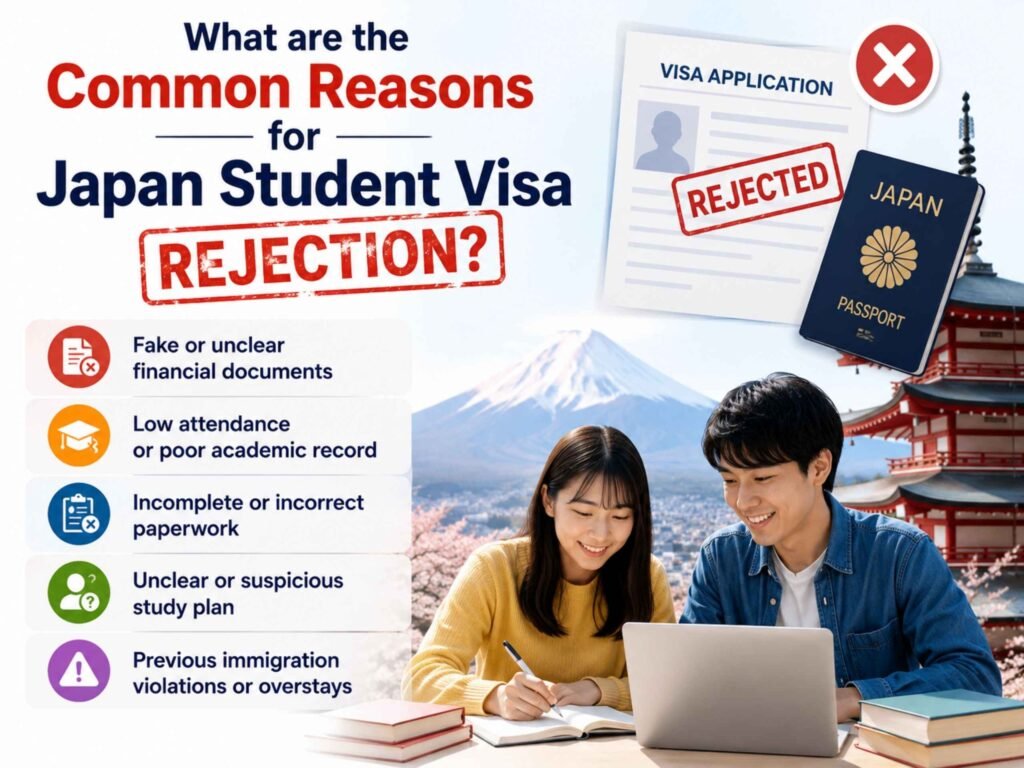
Fake or unclear financial documents are the number one reason for rejection. Immigration officers verify bank statements rigorously.
Low attendance history impacts students trying to renew their visas or move from a language school to a university. Incomplete paperwork, such as missing translations or unsigned forms, will delay or ruin an application.
Suspicious study plans also trigger rejections. If a 40-year-old applicant with a background in engineering applies to study basic Japanese without a clear career goal, immigration may doubt their intent. Immigration history problems, such as past overstays in Japan or deportation from other countries, heavily damage approval chances.
How can you increase your Japan Student Visa approval chances?
Prepare strong financial proof. Ensure your bank statements are clear, consistent, and show a natural accumulation of wealth rather than sudden, unexplainable deposits.
Write a clear study plan. Explain exactly why you need to study in Japan, why you chose your specific school, and how this education connects to your future career in your home country.
Choose accredited schools that have a strong track record with immigration. Maintain honest documentation. Never forge documents or hide past visa rejections. Follow embassy instructions carefully, as specific document requirements can vary slightly depending on your local Japanese consulate.
How much does it cost to study in Japan in 2026?
Tuition fees vary by institution type. Expect to pay around 800,000 JPY annually for language schools and up to 1.5 million JPY for private universities.
Accommodation costs range from 40,000 JPY for shared dormitories to 100,000 JPY for private apartments in central Tokyo. Food and transportation will cost an average student about 40,000 to 60,000 JPY per month.
Health insurance is mandatory. International students must join the National Health Insurance (NHI) system, which costs roughly 1,500 to 2,500 JPY per month and covers 70% of medical bills. Your estimated yearly budget should sit between 1.5 million and 2.5 million JPY, depending on your lifestyle and location.
What are the best cities in Japan for international students?
- Tokyo: The capital offers the most language schools, universities, and part-time job opportunities, but it features the highest cost of living.
- Osaka: Known for its friendly locals and amazing food, Osaka is slightly cheaper than Tokyo while still providing a massive metropolitan experience.
- Kyoto: The historical heart of Japan is perfect for students interested in traditional culture and houses several prestigious universities.
- Fukuoka: Located in southern Japan, Fukuoka is highly affordable, boasts a warm climate, and is actively growing its startup and international student communities.
- Nagoya: An industrial hub located between Tokyo and Osaka, Nagoya offers excellent engineering and business schools with a balanced cost of living.
Frequently Asked Questions (FAQ) about Japan Student Visas
Can students work full-time during holidays?
Yes, international students can work up to 40 hours per week during extended school holidays, provided they have the proper work permit sticker and their school officially recognizes the holiday period.
How long does visa processing take?
Securing the Certificate of Eligibility in Japan takes two to three months. Once you receive the COE, the embassy visa processing takes an additional three to seven working days.
Can a student change schools?
Yes, changing schools is possible if you graduate or complete your current program. However, quitting a school midway to join another requires strict reporting to immigration and a highly valid reason to avoid visa cancellation.
Can a student convert to a work visa later?
Yes. Once you graduate from a Japanese university or vocational school and secure a full-time job offer from a Japanese company, you can change your residence status from a Student Visa to a standard working visa.
Is the Japanese language mandatory?
Japanese is mandatory if you are attending a language school or a degree program taught in Japanese. It is not strictly mandatory for English-taught university programs, though learning the language drastically improves your daily life and job prospects.
Final thoughts on studying in Japan
The Japan Student Visa rules in 2026 prioritize genuine education, strict attendance, and clear financial backing. Navigating the digital updates, maintaining the required bank balances, and respecting the 28-hour work limit are essential steps for a successful stay.
Studying in Japan opens doors to global networking, unique cultural experiences, and excellent career pathways. If you plan your finances carefully and choose the right institution, your educational journey will be highly rewarding. Always verify the latest requirements with your local Japanese embassy or consulate before applying, as regional regulations can shift.

