

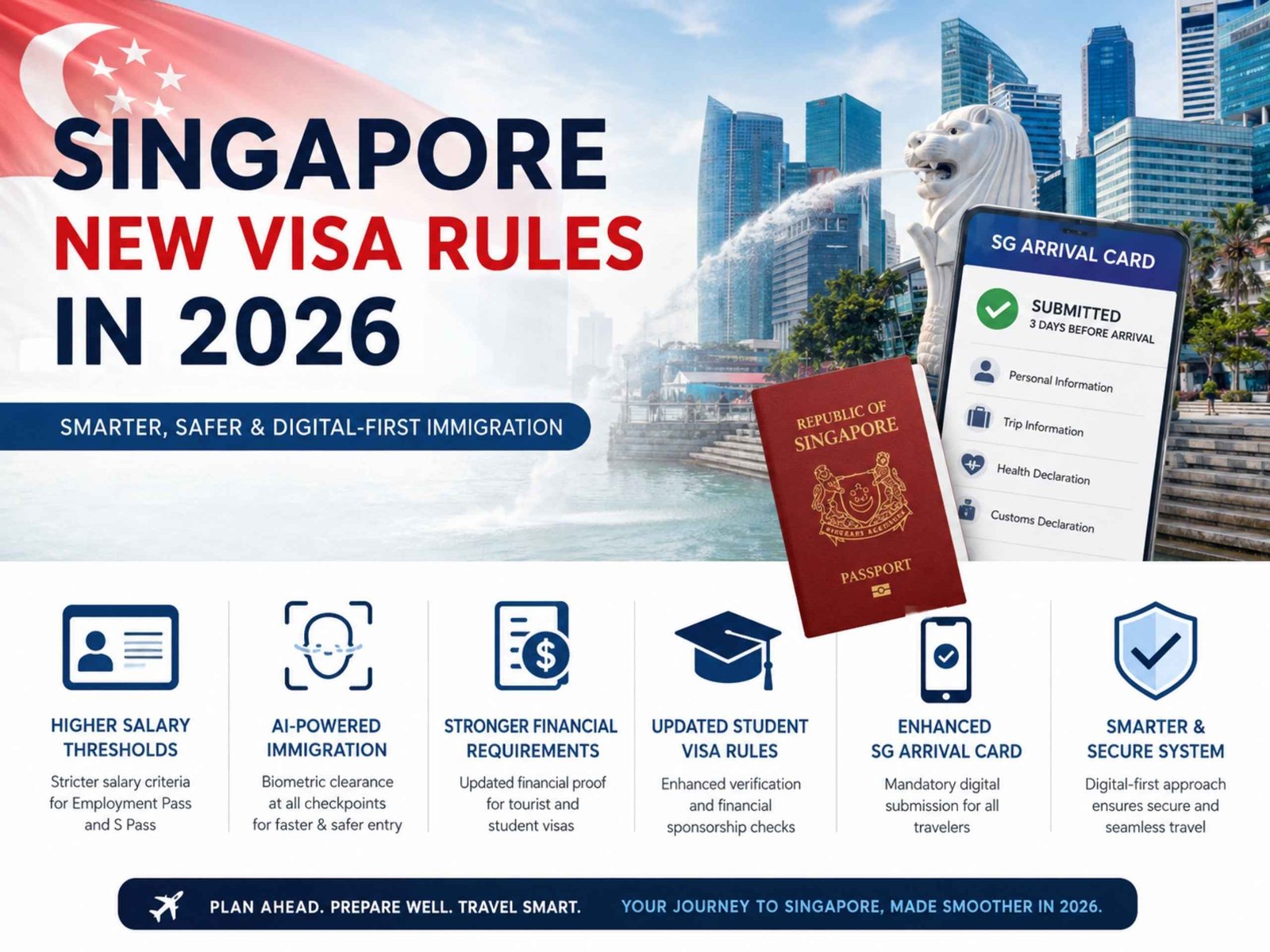
The Singapore new visa rules in 2026 introduce stricter salary thresholds for the Employment Pass, mandate AI-powered biometric clearance at all checkpoints, and require updated financial proof for tourist and student visas. Travelers and foreign workers must use the enhanced SG Arrival Card system for faster, digital-first immigration processing.
Singapore has consistently maintained a reputation as a leading global hub for business, education, and tourism. To sustain this reputation while managing domestic resources, the Singapore government periodically updates its immigration framework. The newly implemented 2026 visa regulations bring significant shifts that affect everyone from short-term holidaymakers to long-term expatriates.
Understanding these updated policies is critical for anyone planning to visit or relocate to the city-state. The revised framework emphasizes digital modernization, enhanced security measures, and a more stringent selection process for foreign talent. This comprehensive guide breaks down the specific changes, required documents, and application steps so applicants can navigate the updated immigration landscape with confidence.
Table of Contents
Why did Singapore change its visa rules in 2026?
The 2026 updates to the Singapore immigration system stem from several strategic national priorities. Singapore experienced a massive surge in post-pandemic tourism and business travel, which placed heavy demands on border control infrastructure. By transitioning to a fully digital immigration modernization framework, the Immigration & Checkpoints Authority (ICA) can process high volumes of travelers securely and efficiently.
Security and compliance updates also drove these changes. The global landscape requires advanced biometric screening and real-time background checks to prevent immigration fraud. Furthermore, Singapore’s Ministry of Manpower (MOM) aims to attract top-tier global talent and investors while protecting the local workforce. The government achieves this balance by raising the qualifying criteria for work visas, ensuring that only highly skilled foreign professionals fill critical industry gaps.
What is the overview of the new Singapore visa rules for 2026?
The 2026 immigration overhaul touches almost every visa category. The government has prioritized a seamless digital experience while tightening the eligibility criteria for long-term passes.
What are the key changes at a glance?
For short-term visitors, the updated tourist visa requirements now demand more robust financial proof and mandatory digital applications. Work permit policies have undergone the most rigorous adjustments, with increased minimum salary requirements for the Employment Pass (EP) and S Pass categories.
Additionally, the SG Arrival Card has received significant updates, acting as the central digital hub for all health and immigration declarations. While the new AI-powered e-visa systems allow for faster processing times for standard applications, complex cases face longer review periods due to enhanced background checks.
Students planning to study abroad can also explore the latest updates on Japan Student Visa Rules 2026 for detailed information about eligibility, financial requirements, and application procedures.
How do the Singapore tourist visa changes affect travelers in 2026?
Tourism remains a vital pillar of the Singapore economy. However, the ICA has refined the entry requirements to ensure visitors have genuine intentions and sufficient funds to support their stay.
What are the new requirements for tourists entering Singapore?
Tourists must navigate several updated protocols before boarding their flights. The updated passport validity rules strictly enforce a minimum of six months of validity from the date of entry. Mandatory online applications have entirely replaced paper-based visa requests. Depending on the traveler’s country of origin, the ICA may require specific travel insurance policies that cover unexpected medical emergencies.
Financial document requirements are now more stringent. Tourists from countries requiring a visa must upload certified bank statements proving they can sustain themselves during their holiday. Return ticket rules are also heavily enforced; airlines and immigration officers will deny entry if a traveler cannot present a confirmed onward or return ticket.
Which countries get visa-free entry updates in 2026?
The Ministry of Foreign Affairs periodically reviews diplomatic agreements, leading to countries being added or removed from visa-free access lists. In 2026, Singapore expanded visa-free privileges to several emerging business hubs in South America and Eastern Europe, while reducing the maximum stay duration for certain other nations from 90 days to 30 days [Ministry of Foreign Affairs, 2026]. Travelers must verify their specific nationality’s status on the ICA website prior to booking flights.
What are the new work visa and Employment Pass rules for Singapore?
Foreign professionals seeking employment in Singapore face a highly competitive landscape in 2026. The Ministry of Manpower has implemented strict guidelines to elevate the quality of the foreign workforce.
What are the Employment Pass (EP) updates for professionals?
The Employment Pass (EP) is designed for foreign professionals, managers, and executives. The 2026 updates introduce an increased minimum salary requirement, pushing the baseline significantly higher than previous years. Older, more experienced applicants face proportionally higher salary thresholds to qualify.
Skills and qualification standards are heavily scrutinized through the points-based COMPASS (Complementarity of Assessment Framework) system. Applicants earn points based on their salary relative to local peers, their qualifications, and their company’s diversity. Furthermore, a new employer verification process requires companies to submit comprehensive data proving they attempted to hire local citizens before offering the role to a foreign candidate.
How are S Pass and Work Permit changes impacting specific industries?
The S Pass (for mid-level skilled staff) and Work Permit (for semi-skilled workers) categories also face tighter controls. Industry-specific rules dictate exactly how many foreign workers a company can hire in sectors like construction, manufacturing, and services. The government has updated the foreign worker quota (Dependency Ratio Ceiling) to encourage automation and reduce reliance on manual labor. Consequently, employers must pay higher foreign worker levies, making it more expensive to hire non-local staff.
What are the student visa rules for international students studying in Singapore?
Singapore remains a premier destination for global education. The 2026 Student’s Pass rules ensure that international students possess the necessary academic background and financial backing to succeed.
New document requirements mandate that all educational transcripts be digitally verified through approved global credentialing agencies. Financial sponsorship rules dictate that the student, or their parents, must show liquid assets capable of covering full tuition and living expenses for the first academic year.
The university verification process is now directly integrated with the ICA database, meaning schools must instantly report attendance issues or academic failures. Regarding part-time work permissions, the MOM has clarified that only students enrolled in specific, approved institutions may work up to 16 hours a week during term time.
How do the Singapore Digital Arrival Card and immigration updates work in 2026?
The physical immigration counter is rapidly becoming a thing of the past. The SG Arrival Card system in 2026 is a mandatory digital declaration that all travelers must complete within three days prior to arrival.
Biometric verification changes mean that facial and iris recognition scanners have replaced passport stamping. These AI-powered immigration checkpoints match the traveler’s face to the data submitted via the SG Arrival Card and the e-visa system. This integration allows for a significantly faster airport clearance process, often taking less than 15 seconds for pre-approved travelers to pass through the automated lanes at Changi Airport.
What is the step-by-step visa application process in 2026?
Navigating the Singapore visa application requires attention to detail. Follow these steps to ensure a smooth process.
How do you submit a Singapore visa application?
- Choose visa type: Determine if you need a short-term tourist visa, an Employment Pass, or a Student’s Pass based on your travel intent.
- Prepare required documents: Gather bank statements, employment letters, and educational certificates. Digitize all documents into high-resolution PDF formats.
- Submit online application: Access the official ICA or MOM portal using a Singpass account (for local sponsors) or the authorized electronic portal.
- Pay visa fees: Use a secure digital payment method to cover the non-refundable processing charges.
- Attend interview (if required): While rare for tourist visas, certain work pass applicants may need to attend a virtual interview to verify their credentials.
- Receive approval: The ICA issues an In-Principle Approval (IPA) letter or an e-Visa digitally. Print this document for your flight.
What is the processing time for different Singapore visas?
The tourist visa timeline typically spans 3 to 5 working days, assuming all documents are correct. The work visa timeline is notably longer; MOM takes between 3 to 8 weeks to evaluate the employer’s credentials and the applicant’s COMPASS score. The student visa timeline generally takes 2 to 4 weeks, largely depending on how quickly the educational institution submits their portion of the application.
What are the required documents for a Singapore visa in 2026?
Accuracy in documentation is non-negotiable. The required documents for a standard Singapore visa include:
- Valid passport: Must have at least six months of validity remaining.
- Passport-size photos: Must meet strict digital biometric standards (white background, taken within the last three months).
- Bank statements: Three months of certified financial records proving adequate funds.
- Travel itinerary: Confirmed flight tickets and hotel bookings.
- Invitation letter (if needed): A letter from a local sponsor or business partner explaining the purpose of the visit.
- Employment or student documents: Contracts, salary slips, or university acceptance letters.
How much are the Singapore visa fees in 2026?
Visa costs have adjusted to reflect the enhanced digital processing infrastructure. Tourist visa fees generally sit around SGD $30, though authorized agents may charge an additional service fee. Work visa application costs involve multiple tiers; employers must pay an initial application fee of approximately SGD $105, followed by an issuance fee upon approval. Student visa charges include a processing fee and an issuance fee, totaling around SGD $90 to $120. Choose official payment portals to avoid hidden additional service fees charged by unauthorized third parties.
What are the common reasons for Singapore visa rejection?
The ICA does not provide explicit reasons for visa rejections, but applicants frequently fail for predictable reasons. Incomplete documents or poorly translated certificates are the primary culprits. Weak financial proof leads immigration officers to doubt the applicant’s ability to fund their stay. Previous immigration violations, such as overstaying a prior visa, almost guarantee an automatic rejection. Finally, incorrect application details—such as spelling errors or unmatched passport numbers—will trigger the AI screening system to halt the process.
What are the best tips to avoid a visa rejection?
To maximize approval chances, applicants must submit accurate information that perfectly matches their passport. Apply early, allowing enough buffer time for unexpected delays or requests for additional documents. Always use updated documents; a bank statement from six months ago will not satisfy the ICA’s requirements.
How do the new Singapore visa rules impact travelers and expats?
The 2026 updates create a polarized experience. For highly skilled professionals and compliant tourists, the AI-driven systems mean easier, frictionless entry. The tourism industry benefits from faster airport clearance, enhancing the visitor experience.
However, the rules create stricter entry barriers for mid-level foreign workers and budget travelers. The opportunities for foreign workers are now heavily concentrated in high-growth sectors like technology, green energy, and finance. Challenges for applicants primarily revolve around meeting the soaring minimum salary requirements and navigating the strict compliance checks.
What are the expert tips for a successful Singapore visa application?
Choose digital efficiency over manual processes. The best time to apply is exactly one month before your intended travel date; applying too early or too late can cause logistical headaches. Important mistakes to avoid include submitting blurry photographs and providing inconsistent travel itineraries.
If you possess a complex passport history, consider using authorized visa agents registered with the ICA. Finally, preparing for immigration checks means having all digital documents downloaded to your phone, as well as physical printouts, in case of roaming data issues at Changi Airport.
FAQs about Singapore new visa Rules
Is Singapore visa-free in 2026?
Singapore offers visa-free entry to citizens of many countries, including the US, UK, Australia, and most EU nations. However, nationalities from specific Assessment Level 1 and Level 2 countries still require an advanced e-visa to enter.
How long can tourists stay in Singapore?
Depending on your nationality, tourists can stay between 14 to 90 days. The maximum stay duration is explicitly stamped on the digital visit pass issued at the immigration checkpoint.
What is the new salary requirement for the Employment Pass?
The minimum qualifying salary for a new Employment Pass varies by age and sector but generally starts at a baseline of SGD $5,600 per month for young graduates, scaling up significantly for candidates in their 40s.
Can I extend my Singapore tourist visa?
Tourists can apply for a one-time visa extension of up to 30 days via the ICA e-Service portal. You must apply for this extension at least seven days before your current visit pass expires.
How long does Singapore visa processing take?
Tourist e-visas process in 3 to 5 business days, while Employment Passes and Student’s Passes take between 3 to 8 weeks due to comprehensive background checks.
Final thoughts on navigating Singapore’s 2026 immigration updates
The Singapore new visa rules 2026 reflect a nation striving to balance economic growth with security and local workforce protection. The transition to fully digital applications, AI-powered immigration checkpoints, and stricter financial and salary thresholds demands higher preparation from all applicants.
By understanding these regulations, submitting pristine documentation, and respecting the country’s immigration laws, travelers and professionals can ensure a smooth journey. Because immigration policies adapt continuously to global trends, applicants should regularly consult the official ICA and MOM websites for the most current updates before planning their travel.
Travelers looking for extra protection during international trips can compare coverage options and benefits through Best Travel Insurance Plans Guide before planning their next vacation.

