

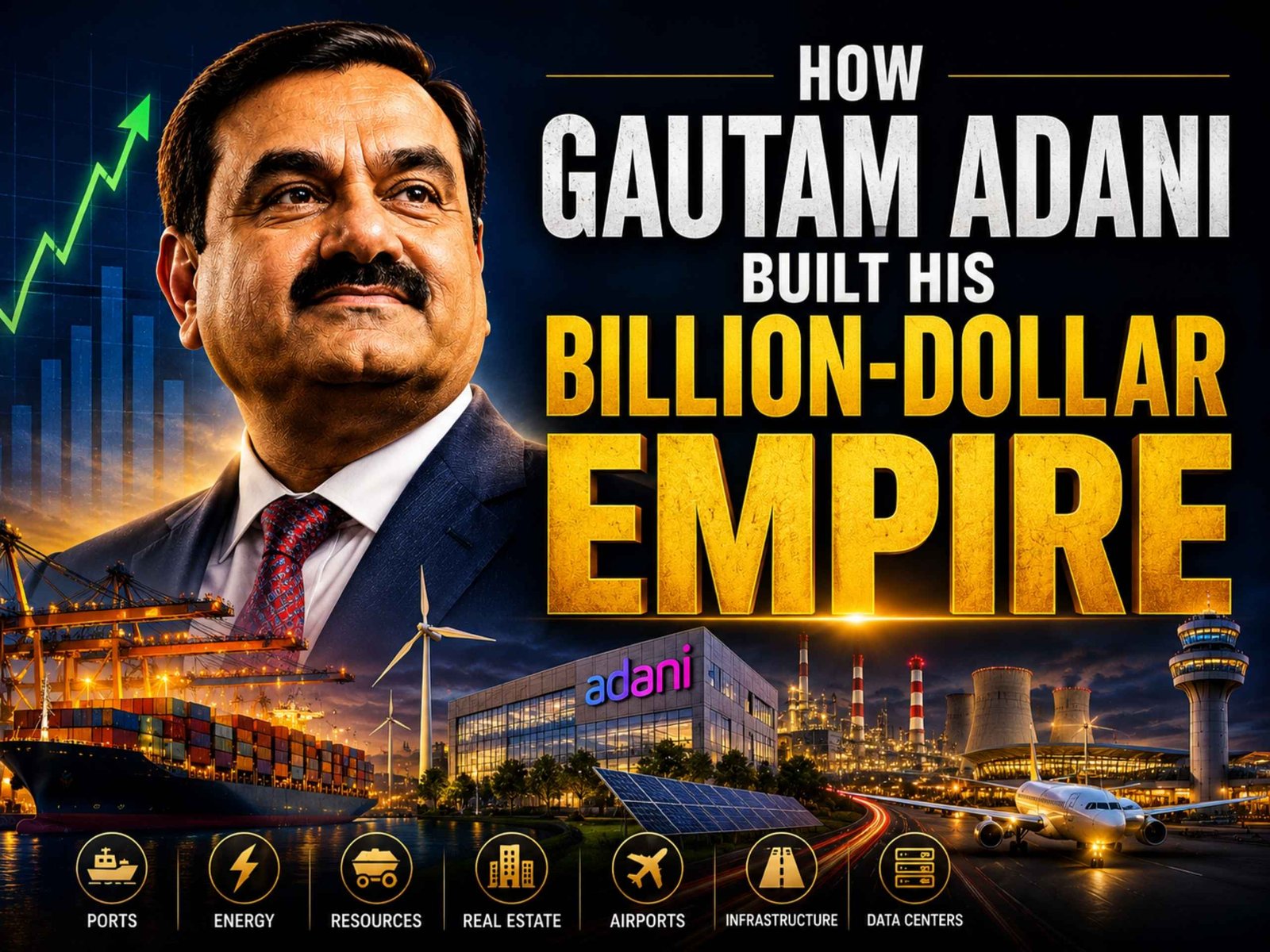
Gautam Adani built his multi-billion-dollar empire by starting as a diamond sorter in Mumbai before launching a plastics brokerage. In 1988, Gautam Adani founded Adani Enterprises for agricultural trading. His major breakthrough came in 1995 when he secured the contract to manage Mundra Port, which allowed the Adani Group to expand aggressively into power generation, green energy, and infrastructure.
Gautam Adani represents one of the most prominent wealth-generation stories in modern business history. The Indian billionaire transformed a small trading firm into a massive conglomerate that touches almost every aspect of India’s infrastructure. The Adani Group now operates ports, airports, power plants, and renewable energy projects across the globe.
Understanding the trajectory of the Adani Group requires looking at the strategic decisions that propelled a first-generation entrepreneur to the top of global billionaire lists. Gautam Adani consistently aligned his business ventures with India’s national development goals, capitalizing on the country’s push for modernization and privatization.
This post will explore the chronological steps Gautam Adani took to build his enterprise. Readers will learn how the Adani Group scaled its operations, how infrastructure became the foundation of its wealth, and how the conglomerate diversified into new business sectors over three decades.
Table of Contents
How did Gautam Adani start his business career?
Gautam Adani did not inherit a massive family fortune. Born into a middle-class Jain family in Ahmedabad, Gujarat, he briefly attended Gujarat University before dropping out to move to Mumbai in 1978. In Mumbai, Gautam Adani worked as a diamond sorter for Mahendra Brothers. This early job taught him the basics of global trade and commodity valuation.
After a few years in the diamond trade, Gautam Adani returned to his hometown in 1981 to help manage his brother’s plastics company. He began importing primary polymers for small-scale industries. This venture into global trading laid the groundwork for his future empire. In 1988, he officially incorporated Adani Exports Limited, which is known today as Adani Enterprises. Initially, Adani Enterprises focused exclusively on agricultural commodities and power-related commodities.
What was the major breakthrough for the Adani Group?
The trajectory of the Adani Group changed permanently in 1995. The state government of Gujarat decided to outsource the management of the Mundra Port, and Gautam Adani won the contract. Mundra Port provided a massive physical asset that generated steady, long-term cash flow.
Gautam Adani transformed Mundra Port into the largest private port in India. Owning the logistics infrastructure allowed the Adani Group to control the supply chain for its trading businesses. By importing coal through his own port, Gautam Adani could supply raw materials to Indian power plants more efficiently than his competitors. This logistical advantage gave the Adani Group the leverage needed to dominate the Indian commodities market.
How did the Adani Group expand into new business sectors?
Once Mundra Port was fully operational, Gautam Adani used the profits and logistical advantages to expand aggressively into adjacent industries. The Adani Group moved from simply importing coal to generating power. In 2006, the conglomerate entered the power generation sector, eventually becoming India’s largest private thermal power producer.
As the global focus shifted toward sustainability, Gautam Adani pivoted again. The Adani Group invested heavily in renewable energy, setting a goal to become the world’s largest solar power company. The conglomerate also acquired operational rights for multiple major airports across India, making the Adani Group the largest private airport operator in the country.
The following table outlines the major subsidiaries within the Adani Group and their primary business sectors:
| Company Name | Primary Sector | Key Business Focus |
|---|---|---|
| Adani Enterprises | Conglomerate Incubator | Mining, defense, aerospace, and data centers |
| Adani Ports and SEZ | Logistics and Infrastructure | Port management and special economic zones |
| Adani Green Energy | Renewable Energy | Solar and wind power generation |
| Adani Power | Thermal Power | Coal-based power generation |
| Adani Total Gas | Utilities | City gas distribution |
What lessons can entrepreneurs learn from the Adani Group’s growth?
Gautam Adani built his wealth by identifying massive infrastructural gaps in a rapidly developing nation and stepping in to fill them. His strategy relied on asset-heavy industries that required significant capital investment but offered high barriers to entry and long-term monopolies.
Entrepreneurs can look at the Adani Group as a case study in strategic alignment. Gautam Adani consistently matched his business investments with government priorities. When India needed better ports, he built Mundra. When India needed more electricity, he built coal plants. When the focus shifted to climate change, he invested billions in solar farms. By scaling businesses that were essential to national growth, Gautam Adani ensured the longevity and indispensability of his empire.
For more insights into billionaire wealth and India’s corporate giants, check out the detailed breakdown of Mukesh Ambani’s net worth in 2026 along with the list of the Top 10 Richest Indian Businessmen in 2026
Frequently Asked Questions about Gautam Adani and the Adani Group
What is the primary source of Gautam Adani’s wealth?
Gautam Adani’s wealth primarily comes from his ownership stakes in the publicly traded companies under the Adani Group umbrella. Adani Enterprises, Adani Ports and SEZ, and Adani Green Energy contribute the most significant portions to his overall net worth.
How did Gautam Adani acquire the Mundra Port?
In 1995, the Gujarat state government decided to commercialize and expand the Mundra Port through a public-private partnership. Gautam Adani’s company won the management contract and subsequently invested heavily in expanding the port’s capacity, eventually transforming it into India’s largest commercial port.
What are the main controversies surrounding the Adani Group?
The Adani Group has faced scrutiny regarding its debt levels and corporate governance. In early 2023, the U.S.-based short-selling firm Hindenburg Research published a report alleging stock manipulation and accounting fraud within the Adani Group. The conglomerate strongly denied these allegations, though the report temporarily caused a significant drop in the valuation of Adani Group stocks.
Does the Adani Group operate outside of India?
Yes, the Adani Group operates several international businesses. The conglomerate owns the Carmichael coal mine in Queensland, Australia, and operates the Haifa Port in Israel. The Adani Group also manages renewable energy and infrastructure projects in neighboring countries like Sri Lanka and Bangladesh.
If you enjoy reading about billionaire entrepreneurs and modern business empires, you can also explore Elon Musk net worth and learn how MrBeast built his massive net worth through YouTube, businesses, and global branding.

