

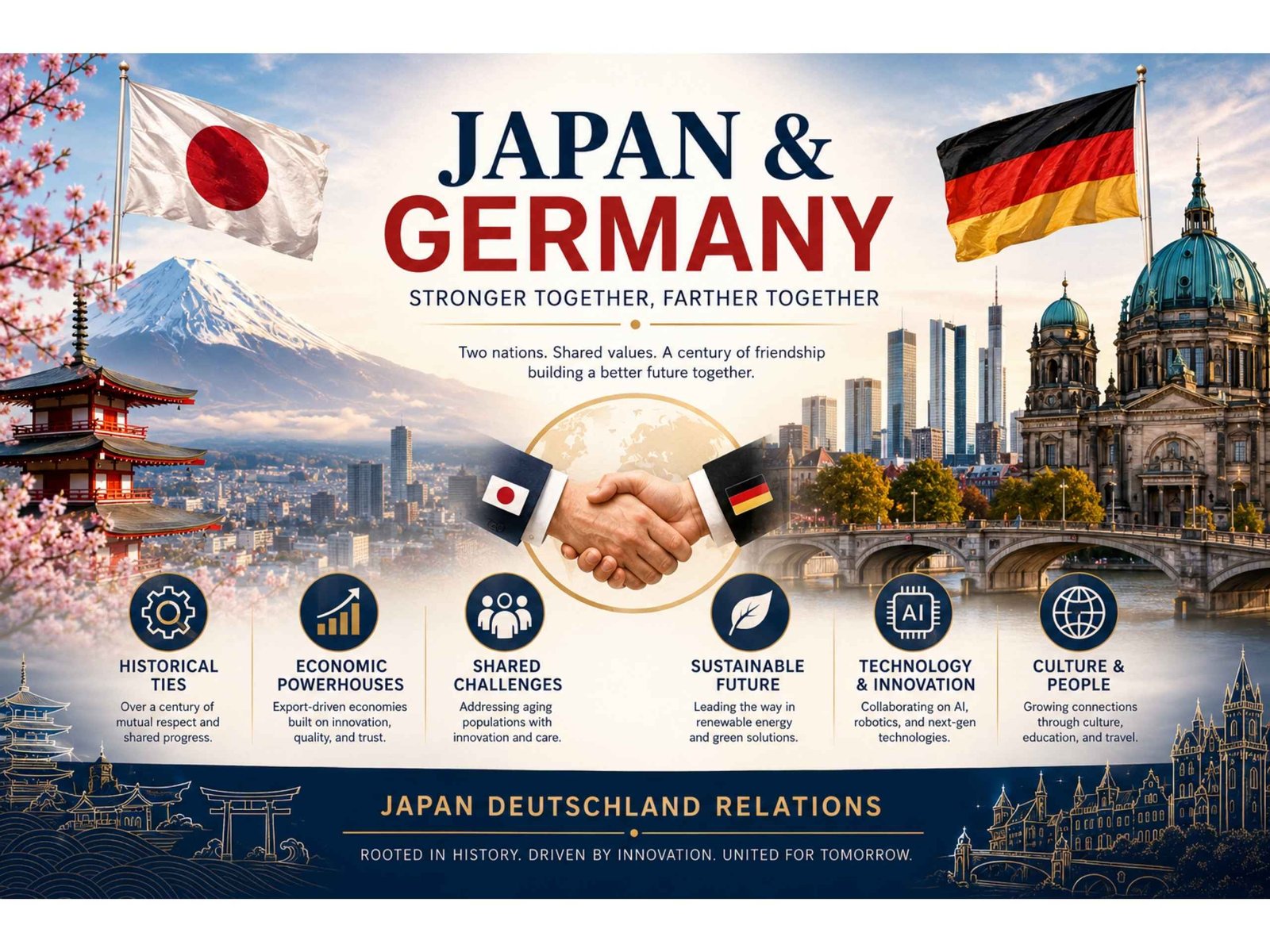
Separated by over 5,000 miles, Japan and Germany appear to exist in entirely different spheres. One is an island nation in East Asia rooted in ancient traditions and rapid technological adoption. The other is a central European powerhouse known for its continental influence and deep historical heritage. Yet, beneath the surface of geography and language, these two nations share a remarkable number of similarities.
Japan Germany Relations —often highlighted in international studies under the banner of Japan Deutschland relations—spans over a century of mutual respect, economic parallel, and cultural exchange. Both nations have navigated turbulent histories to emerge as leading democratic societies with robust, export-driven economies. They have consistently prioritized precision engineering, manufacturing excellence, and high-quality education.
Understanding the unique bond between Japan and Germany provides valuable insights into global economics and international diplomacy. As both countries face modern hurdles like aging populations and the urgent need for green energy transitions, their ongoing partnership will likely shape global policies for decades to come.
This post explores the historical ties, economic similarities, shared challenges, and cultural exchanges that define the enduring connection between Japan and Germany.
Table of Contents
Historical Foundations of Japan-Germany Relations
The diplomatic and cultural ties between Japan and Germany are not a recent phenomenon. They were forged during critical periods of modernization and state-building.
The Meiji Restoration and German Influence
During the late 19th century, Japan opened its doors to the world after centuries of isolation. The Meiji government actively sought out Western knowledge to modernize the country. German legal systems, military organization, and medical sciences became foundational models for Japan’s development. Japanese scholars traveled to Germany to study, and German experts were invited to Japan to help build modern academic and governmental institutions. This era established a deep-rooted academic and professional respect that persists today.
Post-War Economic Miracles
The mid-20th century saw both nations devastated by the aftermath of World War II. Stripped of their military power and facing ruined infrastructure, Japan and Germany had to rebuild from scratch. Through sheer resilience, heavily focused industrial policies, and international support, both countries experienced rapid economic recoveries. The German Wirtschaftswunder (economic miracle) and the Japanese post-war economic miracle occurred almost simultaneously. By the 1970s, both had transformed into the strongest economies in their respective regions.
Economic Parallels and Global Influence
Today, Japan and Germany rank among the top economies globally. Their economic structures mirror one another in several fascinating ways.
Engineering and Automotive Titans
When consumers think of reliable engineering, Japanese and German brands immediately come to mind. Companies like Toyota, Honda, Volkswagen, and BMW dominate the global automotive market. Both countries share a cultural dedication to craftsmanship—known as Monozukuri in Japan and Ingenieurskunst in Germany. This commitment to high-quality manufacturing extends beyond cars to machinery, electronics, and precision instruments.
Export-Driven Economies
Neither Japan nor Germany possesses vast natural resources. To build wealth, they rely heavily on importing raw materials, adding immense value through advanced manufacturing, and exporting finished goods. This export-centric model has created a strong mutual understanding regarding global trade policies. Both nations consistently champion free trade agreements and stable international markets, as their economic survival depends on open global commerce.
Navigating Shared Demographic Challenges
As highly developed nations, Japan and Germany are currently confronting identical social and demographic hurdles. Their approaches to solving these issues often involve collaborative research and shared policy frameworks.
Aging Populations
Japan has the oldest population in the world, with a significant percentage of its citizens over the age of 65. Germany follows closely behind, holding the title for the oldest population in Europe. Declining birth rates and increased life expectancy have put immense pressure on healthcare systems and pension funds in both countries.
Workforce Innovations
To combat the shrinking labor force, both nations are exploring innovative solutions. Germany has historically relied on immigration to bolster its workforce, while Japan has focused heavily on automation and robotics. Recently, however, there has been a convergence in their strategies. Germany is rapidly advancing its industrial automation, and Japan is gradually opening its doors to foreign workers. They frequently exchange data and strategies on integrating AI and robotics into eldercare and manufacturing to sustain productivity.
The Future of the Japan Deutschland Partnership
As the global landscape shifts, the bilateral focus between Japan and Germany is pivoting toward future-proofing their economies and protecting the environment.
Renewable Energy and Sustainability
Following the 2011 Fukushima disaster, both countries made significant commitments to alter their energy grids. Germany accelerated its Energiewende (energy transition) to phase out nuclear power in favor of renewables. Japan has also invested heavily in solar, wind, and hydrogen energy. The two governments regularly hold bilateral summits to share research on hydrogen fuel cells and energy-efficient building technologies, aiming to become global leaders in the green economy.
Technological Advancements and AI
While both countries excel in hardware and traditional engineering, they face fierce competition from the US and China in software and artificial intelligence. To maintain their competitive edge, Japanese and German research institutes are forming joint ventures. Collaborative projects in artificial intelligence, Internet of Things (IoT) applications for manufacturing, and smart city developments are currently underway, ensuring both nations remain at the cutting edge of the fourth industrial revolution.
Cultural Exchanges and Tourism
The relationship is not purely transactional or economic. There is a profound cultural affinity between the citizens of both countries.
Japanese classical musicians frequently study in Germany, drawn by its rich musical heritage. Conversely, German interest in Japanese pop culture, anime, and traditional arts continues to surge. Cities like Düsseldorf host one of the largest Japanese communities in Europe, complete with authentic bakeries, bookstores, and an annual Japan Day festival that draws hundreds of thousands of visitors.
Tourism between the two nations remains strong. German tourists flock to Kyoto and Tokyo for a blend of historical temples and neon-lit modernity. Japanese tourists travel to Bavaria and the Rhine Valley to experience historic castles and traditional European landscapes. This continuous exchange fosters a mutual appreciation that strengthens diplomatic ties.
Frequently Asked Questions (FAQ)
What is the trade relationship like between Japan and Germany?
Japan and Germany share a robust trade relationship. Germany is Japan’s largest trading partner in Europe, while Japan is one of Germany’s most important trading partners in Asia. They primarily exchange machinery, vehicles, electronics, and chemical products.
Why do Japan and Germany have similar economic structures?
Both countries rebuilt their economies after World War II by focusing on high-quality manufacturing and exports. Lacking abundant natural resources, they invested heavily in education, engineering, and technology to produce premium goods for the global market.
How are both countries addressing their aging populations?
Japan and Germany are heavily investing in automation, healthcare robotics, and artificial intelligence to support their aging citizens. Germany also utilizes targeted immigration policies to sustain its workforce, a strategy Japan is slowly beginning to adopt.
Looking Ahead at a Powerful Alliance
The synergy between Japan and Germany proves that shared values and common economic goals can bridge vast geographical and cultural divides. Their historical resilience has shaped them into modern pillars of democracy and industry. As they tackle the complexities of the 21st century—from climate change to demographic shifts—their collaborative efforts will serve as a blueprint for other developed nations.
By continuing to foster innovation and mutual respect, the Japan Deutschland partnership will undoubtedly remain a driving force in shaping a stable, prosperous global future.

