

Moving to Japan for work is an exciting prospect for many Indian professionals. The country offers a unique blend of rich historical culture, cutting-edge technology, and excellent career advancement opportunities. Navigating a foreign immigration system, however, can often feel overwhelming, especially when applying for a Japan work visa. Understanding the specific requirements and steps involved is crucial to making your transition as smooth as possible.
When looking to secure a Japan work visa as an Indian professional, preparation is your best asset. The Japanese government has created several visa categories designed to attract international talent, especially in fields like engineering, IT, healthcare, and specialized trades. By knowing which category fits your skills, you can streamline the application process.
This comprehensive guide covers everything you need to know about securing your Japanese work visa. We will walk through the different types of visas available, the basic eligibility requirements, the exact documents you need, and the step-by-step application process.
Table of Contents
Types of Japan Work Visas for Indians
Japan does not issue a single, generic “work visa.” Instead, the government provides specific visa categories based on your profession and skill level. Selecting the correct visa type is the very first step in your journey.
Engineer / Specialist in Humanities / International Services
This is the most common work visa for foreign professionals, including Indian citizens. It covers a broad range of white-collar jobs. If you are an IT professional, software engineer, language teacher, marketing specialist, or business consultant, you will likely apply for this category. You need a university degree relevant to your field or equivalent professional experience to qualify.
Highly Skilled Professional (HSP) Visa
The HSP visa is designed for top-tier talent and uses a point-based system. Points are awarded based on factors like your educational background, professional experience, annual salary, and Japanese language proficiency. If you score 70 points or higher, you can enjoy preferential immigration treatment. Benefits include a five-year visa validity, easier pathways to permanent residency, and the ability to bring your parents or a domestic worker under certain conditions.
Specified Skilled Worker (SSW) Visa
Introduced to address labor shortages, the SSW visa is aimed at workers in specific industries such as nursing care, construction, agriculture, and food service. To obtain this visa, applicants usually need to pass a skills test and a basic Japanese language exam. This route is excellent for individuals looking to work in foundational sectors of the Japanese economy.
Basic Requirements and Eligibility
Before starting the paperwork, you must ensure you meet the fundamental criteria set by the Japanese immigration authorities.
Securing a Japanese Employer
You cannot simply apply for a work visa to look for jobs in Japan. You must have a confirmed job offer from a company based in Japan. Your future employer acts as your sponsor and plays a critical role in the initial stages of your visa application.
The Certificate of Eligibility (COE)
The Certificate of Eligibility is the most important document in the Japanese immigration process. Your employer applies for this document on your behalf at the regional immigration bureau in Japan. The COE serves as proof that you meet the conditions for entering Japan and that your intended activities are valid under Japanese immigration law.
Educational and Professional Qualifications
For most professional visas, a bachelor’s degree is the minimum educational requirement. The degree should ideally align with the job you are taking. If you do not have a degree, you typically need to prove 10 years of relevant professional experience (or 3 years for certain international services roles).
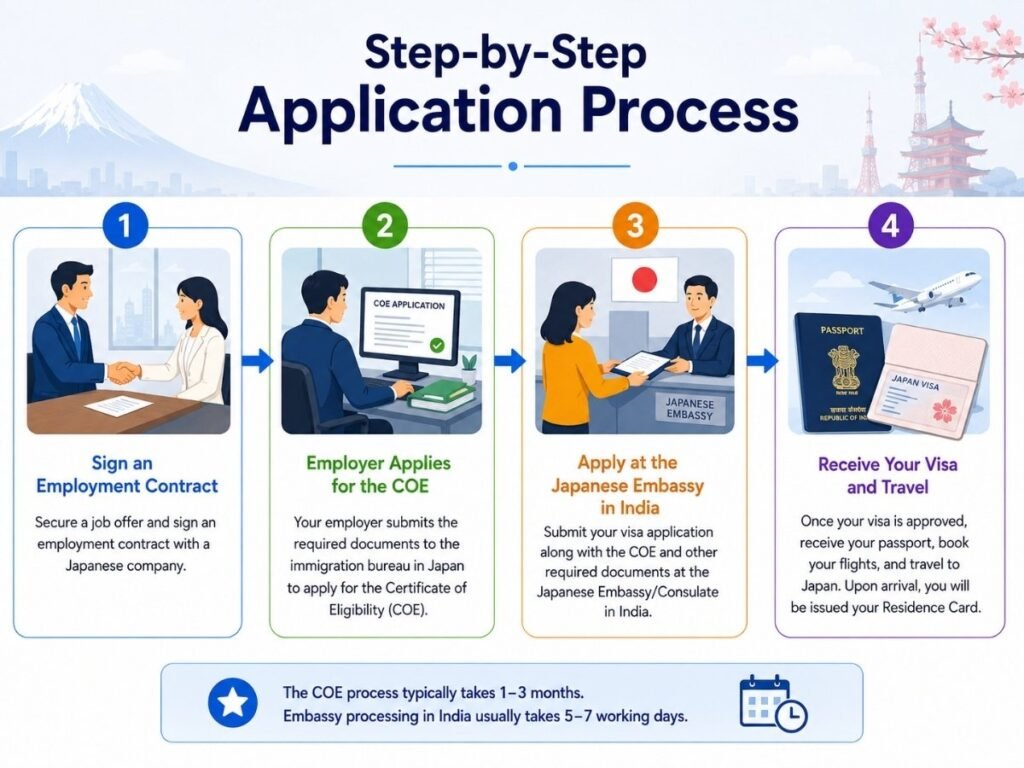
Step-by-Step Application Process
Understanding the workflow of the application will help you manage your timeline and expectations.
Step 1: Sign an Employment Contract
Your journey begins with successfully interviewing and signing an employment contract with a Japanese company. Ensure the contract clearly states your salary, role, and employment duration.
Step 2: Employer Applies for the COE
Once the contract is signed, you must send your educational certificates, resume, and passport copies to your employer. They will submit these documents, along with company-specific paperwork, to the immigration bureau in Japan to apply for your COE. This process generally takes between one to three months.
Step 3: Apply at the Japanese Embassy in India
After the COE is issued, your employer will mail the physical or digital document to you in India. You must then submit your visa application at the Japanese Embassy in New Delhi or the Consulates in Mumbai, Chennai, Kolkata, or Bengaluru, depending on your jurisdiction. You can often process this through a trusted visa agency (VFS Global).
Step 4: Receive Your Visa and Travel
The embassy processing time in India usually takes about five to seven working days. Once your passport is returned with the visa stamp, you are ready to book your flights. Upon arriving at an airport in Japan, immigration officials will review your COE and visa, and issue your Residence Card.
Required Documents for Your Application
Having your paperwork organized prevents unnecessary delays. When applying at the embassy in India, you will generally need:
- A valid Indian passport with at least two blank pages.
- A completed visa application form.
- A recent passport-sized photograph meeting specific dimension requirements.
- The original Certificate of Eligibility (and a photocopy).
- A copy of your employment contract.
- Your educational degree certificates and professional experience letters.
Frequently Asked Questions (FAQ)
How long does it take to process a work visa for an Indian in Japan?
The longest part of the process is obtaining the Certificate of Eligibility, which can take 1 to 3 months. Once you have the COE, the actual visa application in India usually takes just 5 to 7 working days.
Can I bring my family to Japan?
Yes. If you hold a valid professional work visa (like the Engineer/Specialist or HSP visa), you can sponsor your spouse and unmarried minor children for a Dependent Visa. They will need their own COE to enter the country.
Do I need to speak Japanese to get a work visa?
Language requirements depend entirely on the visa type and your employer. While IT professionals and English teachers can often secure jobs with zero Japanese skills, having some basic proficiency greatly improves your daily life. The Specified Skilled Worker (SSW) visa does, however, strictly require passing a basic Japanese language test.
Start Your Career Journey in Japan
Securing a Japanese work visa requires patience and meticulous attention to detail. By understanding the distinct visa categories, securing a supportive employer, and carefully managing your Certificate of Eligibility process, you set yourself up for success. Japan offers a highly rewarding professional environment, and obtaining the correct work visa is the foundational step toward building your new life abroad. Gather your documents, prepare for your interviews, and take the first step toward an exciting international career.

