

Japan and India share a rich history of cultural and economic exchange that dates back centuries. However, the modern movement of people between these two Asian powerhouses has taken on a fascinating new shape. Over the past few decades, the demographic landscape of Japan has started to shift, welcoming a surge of foreign workers, students, and professionals.
If you are curious about how many Indians in Japan currently make up this demographic shift, you are looking at a rapidly evolving narrative. Japan is known for its homogenous society, yet it is slowly opening its doors to international talent to combat its aging population and labor shortages. Indian professionals, particularly those in the technology and engineering sectors, have become a vital part of this transition.
Understanding the size and footprint of the Indian population in Japan requires a look at recent immigration data, the specific regions where these communities thrive, and the reasons behind this steady migration. This article explores the current statistics, regional hotspots, and the everyday experiences of Indian expats building their lives in the Land of the Rising Sun.
Table of Contents
A Look at the Numbers: How Many Indians in Japan?
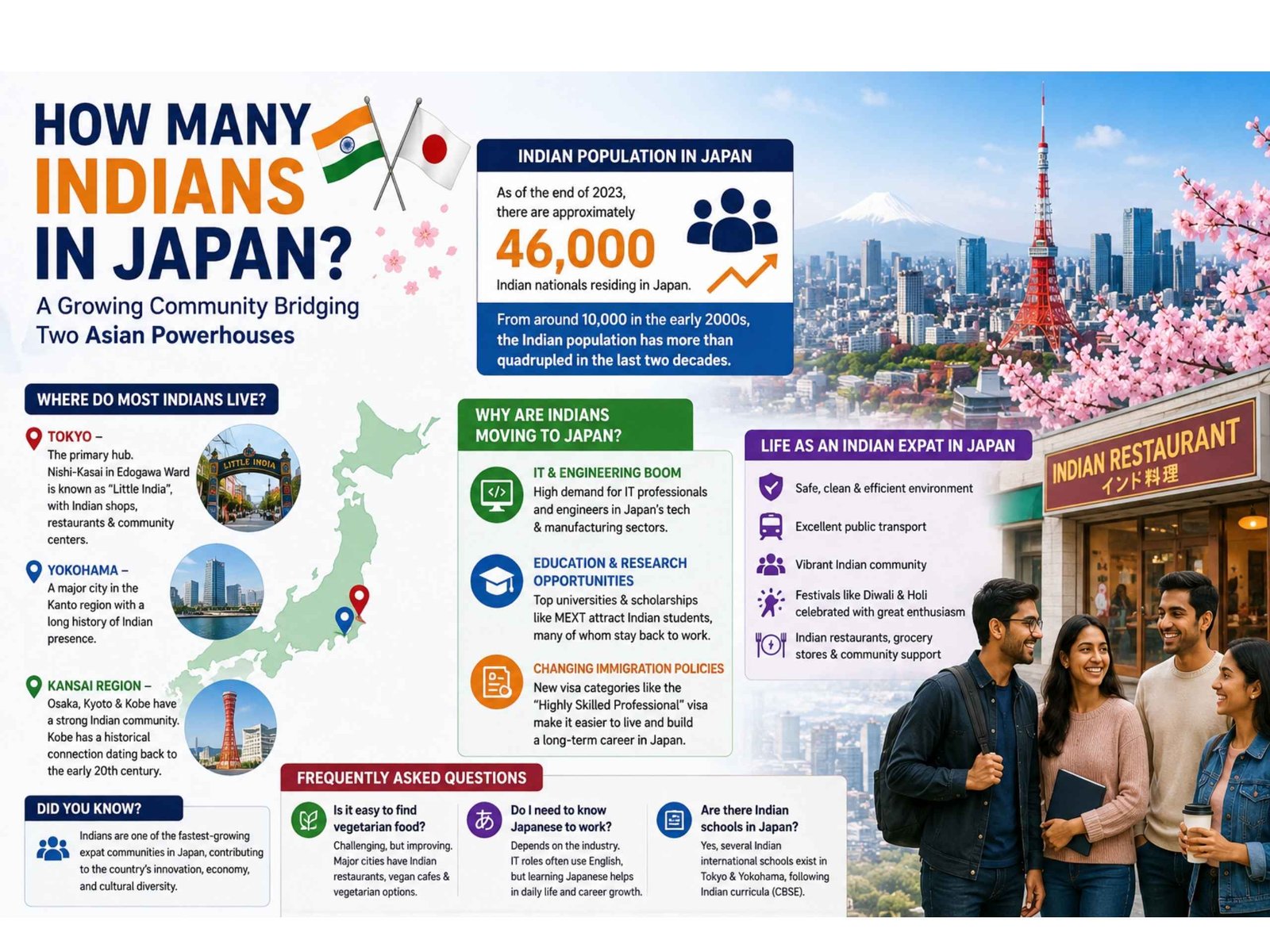
The Indian population in Japan has seen a steady and impressive increase over the last two decades. As of the end of 2023, official data from Japan’s Ministry of Justice indicates that there are approximately 46,000 Indian nationals residing in the country. This makes Indians one of the faster-growing expatriate groups, even if they remain a smaller percentage compared to residents from neighboring countries like China, Vietnam, and South Korea.
To put this growth into perspective, the number of Indians living in Japan hovered around just 10,000 in the early 2000s. The population has more than quadrupled since then. This upward trajectory shows no signs of slowing down, heavily supported by bilateral agreements between the Indian and Japanese governments aimed at boosting the migration of skilled workers.
The demographics of this group are highly skewed toward working-age professionals. A significant portion holds highly skilled professional visas, while others are enrolled in universities or language schools. Family dependents also make up a large portion of the community, indicating that many Indian expats are choosing to settle down and build long-term lives in Japan.
Where Do Most Indian Live in Japan?
While Indian expats are scattered across the country, they are heavily concentrated in major urban centers where corporate headquarters and international universities are located.
Tokyo’s “Little India”
Tokyo is the primary hub for the Indian community. Within the metropolis, the Edogawa Ward is particularly famous for its high concentration of Indian residents. The neighborhood of Nishi-Kasai has even earned the affectionate nickname “Little India.” Walking through the streets of Nishi-Kasai, you will find a vibrant array of authentic Indian grocery stores, restaurants serving regional delicacies, and community centers that host cultural events.
The Kansai Region and Beyond
Beyond Tokyo, the Kanto region (including Yokohama and Kawasaki) hosts a significant number of Indian professionals. Yokohama, in particular, has a historical connection with Indian merchants that dates back to the early 20th century.
Further west, the Kansai region—encompassing Osaka, Kyoto, and Kobe—also boasts a robust Indian community. Kobe has a long-standing history of Indian settlement, originally driven by the textile and pearl trading industries. Today, it remains a culturally significant city for Indian expats, complete with historical temples and established community networks.
Why Are Indians Moving to Japan?
The steady migration of Indian nationals to Japan is driven by a combination of economic opportunities, educational pursuits, and evolving immigration policies.
The IT and Engineering Boom
Japan is a global leader in technology and manufacturing, but it faces a severe shortage of IT professionals and software engineers. Indian tech talent has stepped in to fill this gap. Major Japanese corporations, as well as global tech firms with offices in Tokyo, actively recruit from top Indian engineering institutes.
Education and Research Opportunities
Japanese universities are highly regarded for their research facilities and academic rigor. The Japanese government offers various scholarships, such as the MEXT scholarship, which attracts top-tier Indian students. Many of these students transition into the Japanese workforce after completing their degrees, contributing to the growing number of young Indian professionals in the country.
Japan’s Changing Immigration Policies
Historically, securing a long-term visa in Japan was a notoriously difficult process. In recent years, the government has introduced new visa categories designed to attract foreign talent. The “Highly Skilled Professional” visa offers preferential immigration treatment, including a faster track to permanent residency. These policy changes have made Japan an attractive alternative to traditional expat destinations like the United States or the United Kingdom.
Life as an Indian Expat in Japan
Moving to a country with a vastly different language and culture presents unique challenges and rewards. For many Indian expats, adjusting to the Japanese corporate culture—known for its strict hierarchies and long working hours—requires a period of adaptation. The language barrier is another significant hurdle, as English is not widely spoken outside of major international business hubs.
Despite these challenges, the quality of life in Japan is a major draw. Expats frequently cite the safety, cleanliness, and efficiency of public transport as massive benefits. Furthermore, the Indian community has done an exceptional job of preserving its cultural roots. Major festivals like Diwali and Holi are celebrated with great enthusiasm, often drawing crowds of both Indian expats and curious Japanese locals.
Frequently Asked Questions
Is it easy for Indians to find vegetarian food in Japan?
Finding strictly vegetarian food can be challenging due to the prevalence of fish stock (dashi) in traditional Japanese cooking. However, the situation is improving rapidly. Major cities like Tokyo and Osaka now feature numerous authentic Indian restaurants, vegan cafes, and convenience stores offering clearly labeled plant-based options.
Do I need to know Japanese to work in Japan?
It depends on the industry. IT professionals and English teachers can often get by with minimal Japanese, as many international tech companies operate primarily in English. However, learning Japanese is highly recommended for daily life and is essential if you wish to integrate fully into the local society or advance in traditional Japanese companies.
Are there Indian schools in Japan?
Yes, there are several Indian international schools, primarily located in Tokyo and Yokohama. These schools follow the Indian educational curriculum (such as CBSE), making it easier for expat families to ensure their children receive a continuous education aligned with their home country’s standards.
Embracing the Future of Indo-Japanese Relations
The question of how many Indians in Japan is answered not just by a number on a census, but by the growing cultural and economic impact this community has on the country. From software development to vibrant cultural festivals, Indian expats are weaving themselves into the fabric of modern Japanese society.
As Japan continues to adapt its immigration policies to welcome more international talent, the Indian community is poised for further growth. For professionals and students looking for a safe, technologically advanced, and culturally rich environment, Japan offers a compelling destination to build a rewarding future.

