

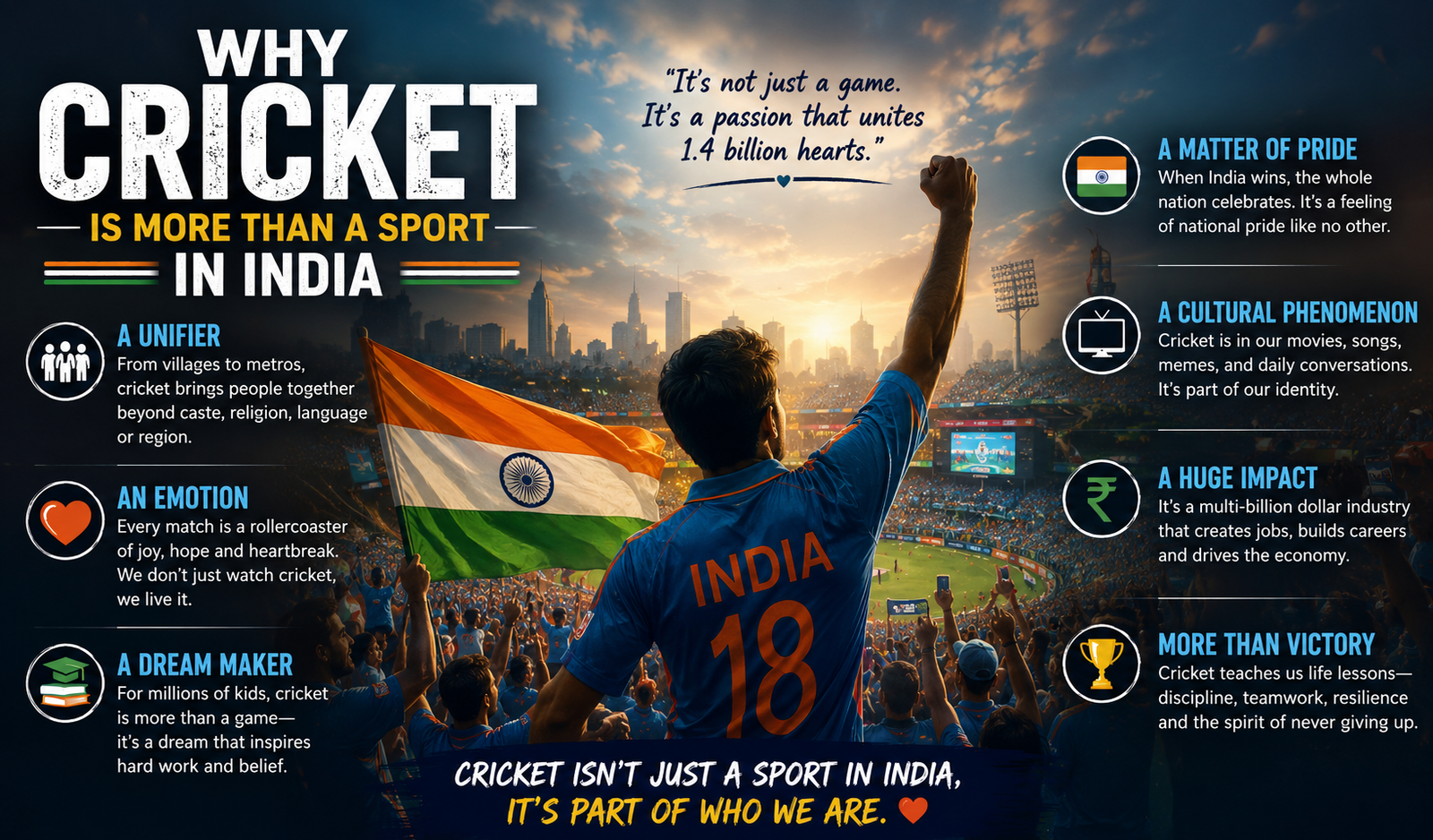
Walk down any busy street in Mumbai, Chennai, or Kolkata during a major tournament, and you will notice a sudden shift in the atmosphere. Traffic miraculously thins out. Shopkeepers huddle around small radios, while office workers discreetly monitor scoreboards on their monitors. A collective gasp echoes from apartment balconies when a wicket falls, followed by deafening cheers for a perfectly executed boundary. The entire nation seemingly pauses, united by a singular focus on a pitch measuring 22 yards.
Understanding India requires understanding its relationship with cricket. For a country boasting over a billion people, 22 official languages, and countless regional traditions, finding common ground can be challenging. Yet, the crack of a willow bat hitting a leather ball resonates across every state line, linguistic barrier, and socioeconomic divide. It provides a shared vocabulary that everyone from a taxi driver to a corporate CEO can speak fluently.
If you want to comprehend the modern Indian identity, you have to look at the pitch. This post explores the historical milestones, economic transformations, and deep emotional connections that elevated a colonial pastime into a unifying cultural phenomenon.
Table of Contents
The Historical Roots of Indian Cricket
To appreciate the current scale of the game, you have to look back at its origins. The British introduced the game to the Indian subcontinent in the 18th century. Initially, it was an exclusive pursuit reserved for colonial officials and European elites. However, local communities slowly began adopting the game, organizing their own clubs and tournaments.
A Colonial Legacy Transformed
The first Indian cricket club, the Oriental Cricket Club, was founded by the Parsi community in Bombay in 1848. Over the decades, other communities followed suit. What started as a way to emulate the British soon became a subtle form of resistance and assertion of equality. Beating the colonizers at their own game provided an immense source of local pride. By the time India gained independence in 1947, the sport had already woven itself into the national fabric.
The Turning Point: The 1983 World Cup
While the sport enjoyed steady popularity post-independence, June 25, 1983, changed the trajectory of Indian sports forever. The Indian national team, led by Kapil Dev, entered the Cricket World Cup in England as severe underdogs. Nobody expected them to advance past the group stages.
Against all odds, they reached the final to face the mighty West Indies, a team considered practically invincible. Defending a modest total of 183 runs, the Indian bowlers pulled off a miraculous victory. That historic win at Lord’s Cricket Ground sparked a nationwide revolution. It proved that India could dominate on the global stage, inspiring millions of children to pick up a bat and dream of representing their country.
A Unifying Force in a Diverse Nation
India’s immense diversity is its greatest strength, but it also creates natural divisions. People from the north and south often consume different media, eat different foods, and celebrate different festivals. Cricket serves as the ultimate social glue.
Bridging Linguistic and Cultural Divides
When the national team plays, regional identities temporarily dissolve. A fan in Punjab feels the exact same anxiety as a fan in Kerala during a tense run chase. The sport creates a sense of national belonging that few other events can replicate. Match days turn into unofficial national holidays, with families and friends gathering to watch the broadcast together.
The Street Cricket Culture (Gully Cricket)
The formal game played in massive stadiums is only half the story. The true soul of the sport lives in “gully cricket”—the informal, street-level version played in alleys, empty lots, and narrow neighborhood lanes.
Gully cricket requires minimal equipment. A taped tennis ball, a wooden plank for a bat, and a stack of bricks or a drawn box on a wall for wickets are all you need. The rules are highly adaptable, changing based on the physical constraints of the playing area. Hitting the ball directly into a neighbor’s window might count as an automatic out. This grassroots version of the game ensures that everyone, regardless of their financial background, has access to the sport. It teaches teamwork, negotiation, and resilience from a very young age.
The Economic Engine of Indian Sports
The passion of a billion fans translates into massive economic power. Over the past two decades, India has become the undisputed financial epicenter of the global game. The Board of Control for Cricket in India (BCCI) is the wealthiest governing body in the sport, generating billions of dollars in revenue.
The Rise of the Indian Premier League
The launch of the Indian Premier League (IPL) in 2008 fundamentally altered the landscape of global sports. The IPL introduced a fast-paced, glamorous format known as Twenty20 (T20), combining high-level athletic competition with Bollywood-style entertainment. Franchise teams representing different Indian cities bid millions of dollars for top international and domestic players at highly publicized auctions.
The IPL created a lucrative career path for domestic players who might never play for the national team. It also spawned a massive ecosystem of jobs, from stadium staff and broadcast technicians to sports marketers and talent scouts.
Brands, Broadcasts, and Billion-Dollar Deals
Corporate sponsors recognize the unmatched reach of the sport in India. Brands eagerly pay premium rates to plaster their logos on team jerseys, stadium billboards, and broadcast graphics. Television broadcasting rights for matches involving the Indian team and the IPL routinely sell for astronomical sums. In recent years, digital streaming platforms have entered the fray, pushing the value of media rights even higher. This influx of capital funds better training facilities, grassroots academies, and higher salaries for players across all levels.
The Worship of Icons
In a country that deeply values heroes and role models, legendary players are elevated to an almost mythical status. They represent the aspirations of the common person, proving that talent and hard work can lead to unparalleled success.
From Gavaskar to Tendulkar
Sunil Gavaskar was the first true superstar of the modern era, setting records and standing tall against the most fearsome fast bowlers of the 1970s and 1980s. However, Sachin Tendulkar took the idolization of athletes to an entirely new level.
Making his international debut in 1989 at the age of 16, Tendulkar carried the hopes of a nation on his shoulders for 24 years. He accumulated a staggering 100 international centuries, a record that remains unbroken. Fans affectionately dubbed him the “God of Cricket.” His humility off the field, combined with his ruthless efficiency on it, made him an idealized figure for multiple generations of Indians.
The Modern Era: Dhoni, Kohli, and Beyond
As Tendulkar’s era concluded, new leaders emerged to carry the torch. MS Dhoni, a small-town boy with an unorthodox playing style, became one of the most successful captains in history. His calm demeanor under extreme pressure earned him the nickname “Captain Cool,” and he led India to victories in the 2007 T20 World Cup and the 2011 Cricket World Cup.
Virat Kohli then took the mantle, bringing a new level of physical fitness, aggressive intent, and global marketability to the team. These icons dictate fashion trends, endorse countless products, and command massive followings on social media. Their influence extends far beyond the boundary ropes.
Frequently Asked Questions (FAQ)
Why is cricket more popular than hockey in India?
Field hockey is actually India’s national sport, and the country boasts a proud Olympic history in the game. However, cricket’s surge in popularity stems from a combination of factors. The 1983 World Cup victory occurred just as color television was expanding across India, allowing millions to witness the triumph. Additionally, the game requires less specialized infrastructure at the grassroots level compared to hockey, making it highly accessible for neighborhood play.
How has women’s cricket grown in India?
Women’s cricket has experienced exponential growth over the past decade. The Indian women’s national team consistently reaches the finals of major global tournaments, creating a new generation of female sports icons. The recent launch of the Women’s Premier League (WPL) has provided financial security and unprecedented media exposure for female athletes, ensuring the sport’s continued expansion.
What is the future of the sport in the country?
The future looks incredibly robust. With massive investments in youth academies, advanced sports science, and regional leagues, the talent pipeline is deeper than ever. The focus is increasingly shifting toward maintaining dominance across all three formats of the game—Test matches, One Day Internationals, and T20s—while continuing to expand the sport’s global footprint.
Embracing the Spirit of Indian Cricket
Cricket operates as a dynamic reflection of India itself. It embodies the nation’s struggles, its vibrant energy, its modernization, and its boundless ambition. The sport provides a reliable rhythm to the chaotic pace of daily life, offering moments of collective joy, heartbreak, and resilience.
From the dusty streets where children swing wooden planks at tennis balls, to the floodlit stadiums holding 100,000 screaming fans, the game weaves a thread that connects over a billion hearts. Understanding this phenomenon reveals why a simple game of bat and ball commands such immense reverence.
If you want to experience this cultural marvel firsthand, try tuning into a high-stakes match. Watch the crowd, listen to the roar of the stadium, and you will quickly realize exactly why this game captures the soul of an entire nation.

