

Running a successful business requires balancing countless moving parts. Your team handles customer inquiries, processes invoices, tracks inventory, and manages marketing campaigns simultaneously. Doing all of this manually leaves very little room for strategic thinking. This is exactly why organizations are turning to artificial intelligence.
AI automation combines the reasoning capabilities of artificial intelligence with the execution power of traditional automation. Instead of just following basic rules, these systems can read text, recognize patterns, and make calculated decisions. This technology allows companies to hand over repetitive tasks to intelligent software, freeing human employees to focus on creative and high-impact projects.
Implementing these tools might seem intimidating at first. Many business owners worry about high costs or complicated technical setups. The reality is that modern AI tools are highly accessible and designed to integrate smoothly with the software you already use. You can start small, automating a single workflow, and expand your efforts as you see positive results.
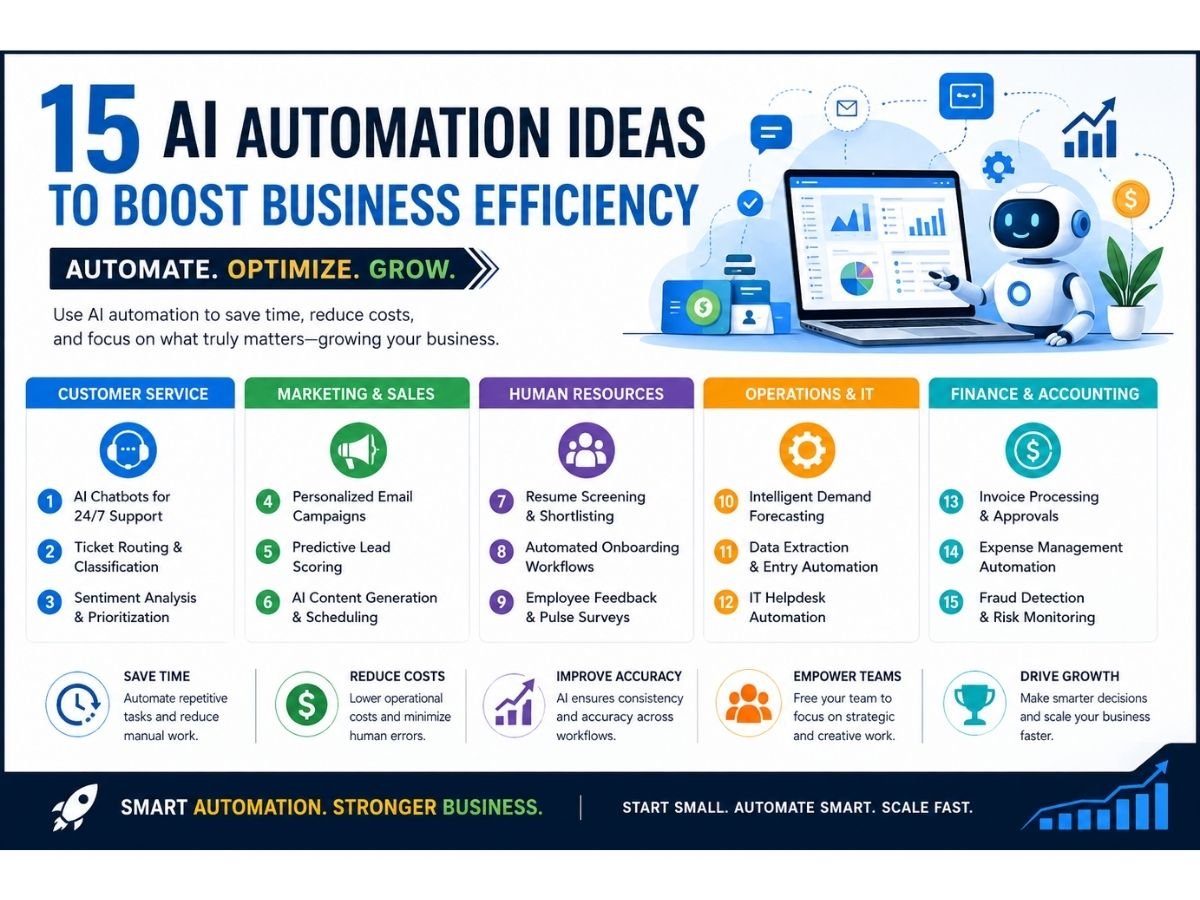
If you want to streamline your operations and reduce manual workload, you need practical starting points. Below, we explore 15 effective AI automation ideas categorized by business function, giving you a clear roadmap to work smarter.
Table of Contents
Customer Service AI Automation Ideas
Customer support teams often face high volumes of repetitive questions. Automating parts of this workflow ensures faster response times and happier customers.
24/7 Intelligent Chatbots
Traditional chatbots follow rigid conversational trees and often frustrate users. AI-powered chatbots use natural language processing to understand the actual intent behind a customer’s question. They can answer complex queries, pull up order statuses, and process basic returns at any time of day. Your customers get immediate answers without waiting for business hours, and your human agents deal with fewer routine requests.
Automated Ticket Routing
When a customer sends a support email, someone usually has to read it and assign it to the correct department. AI can automate this entire triage process. The system analyzes the text of the incoming message, determines if it is a billing issue, a technical glitch, or a sales inquiry, and instantly forwards it to the right specialist. This eliminates bottlenecks and significantly reduces your average resolution time.
Sentiment Analysis for Prioritization
Not all support tickets carry the same urgency. An angry customer threatening to cancel their subscription needs immediate attention. AI sentiment analysis tools scan incoming messages for emotional tone. If the software detects high levels of frustration or urgency, it automatically flags the ticket and pushes it to the top of your support queue. This proactive approach helps you salvage valuable customer relationships before they deteriorate.
Marketing and Sales AI Automation Ideas
Generating leads and nurturing prospects requires consistent effort. AI automation can help your sales and marketing teams scale their outreach without sacrificing personalization.
Personalized Email Campaigns
Sending the exact same email to your entire subscriber list rarely yields great results. AI tools can analyze a subscriber’s past purchase behavior, website browsing history, and email engagement to automatically trigger personalized messages. If a user frequently looks at running shoes on your website, the AI can automatically send them a promotional email featuring your latest athletic footwear. This level of personalization drives higher open rates and conversions.
Predictive Lead Scoring
Sales representatives spend a massive amount of time trying to figure out which leads are actually ready to buy. Predictive lead scoring uses artificial intelligence to evaluate dozens of data points, such as company size, website visits, and engagement levels. The system then assigns a numerical score to every lead in your pipeline. Your sales team can set up automated alerts to contact prospects the moment their score indicates a high buying intent.
Social Media Content Generation and Scheduling
Maintaining an active presence across multiple social media platforms demands constant content creation. You can use AI to analyze current industry trends and automatically generate draft posts, complete with relevant hashtags and image suggestions. The system can also determine the exact times your audience is most active and automatically schedule your posts for maximum visibility, keeping your brand relevant with minimal daily effort.
Human Resources AI Automation Ideas
HR departments juggle recruitment, onboarding, and employee management. AI can handle the administrative burden, allowing HR professionals to focus on company culture and employee wellbeing.
Resume Screening and Shortlisting
Posting a popular job opening can result in hundreds or even thousands of applications. Manually reading each resume is highly inefficient. AI automation tools can scan incoming applications, extract key skills, and compare them against the job description. The software automatically shortlists the most qualified candidates and can even trigger automated emails to schedule initial screening interviews.
Streamlined Employee Onboarding
Welcoming a new hire involves a lot of paperwork and training modules. AI can automate the entire onboarding workflow. Once a candidate accepts a job offer, the system can automatically generate their email address, provision software licenses, and send them a personalized welcome packet. The AI can then drip-feed training materials over their first few weeks, ensuring they get the right information exactly when they need it.
Automated Pulse Surveys and Feedback
Understanding employee morale is critical for retaining top talent. Instead of running a massive annual survey, AI can automate short, frequent pulse surveys. The software intelligently spaces out these check-ins and analyzes the open-ended responses for underlying themes. If the AI detects a rising trend of burnout in a specific department, it alerts HR leadership so they can address the issue proactively.
Operations and IT AI Automation Ideas
Behind every great product or service is a complex web of operational workflows. AI brings visibility and speed to these essential background processes.
Intelligent Demand Forecasting
Running out of stock costs you sales, while overstocking ties up valuable capital. AI automation analyzes historical sales data, seasonal trends, and even external factors like weather patterns to predict future demand. The system can automatically generate purchase orders for your suppliers when stock levels drop below the optimal threshold. This keeps your inventory perfectly balanced with minimal manual oversight.
Data Entry and Extraction
Many businesses still rely on employees to manually type information from PDFs or physical documents into digital databases. Optical character recognition combined with AI can completely automate this process. The software can scan shipping manifests, contracts, or tax forms, identify the relevant data fields, and automatically populate your internal systems with zero typos.
IT Helpdesk Automation
Internal IT teams frequently deal with basic requests like password resets or software access permissions. You can implement an internal AI assistant to handle these routine tasks. When an employee forgets their password, they simply message the AI via your company’s communication platform. The software verifies their identity and automatically resets the password, allowing the IT team to focus on major infrastructure improvements.
Finance and Accounting AI Automation Ideas
Accuracy is everything in finance. Automating financial workflows reduces human error and provides real-time visibility into your company’s cash flow.
Invoice Processing and Approvals
Processing vendor invoices manually involves data entry, matching purchase orders, and chasing down manager approvals. AI can automate the whole cycle. When an invoice arrives via email, the AI extracts the vendor details and amounts, matches it against your purchase orders, and routes it to the correct manager for approval. Once approved, the system automatically queues it for payment in your accounting software.
Smart Expense Management
Reviewing employee expense reports is tedious work. AI tools can allow employees to snap photos of their receipts, while the software automatically extracts the date, merchant, and total amount. The AI then cross-references the expense against your company policy. If a meal expense falls within the allowed daily limit, the system approves it instantly. If it spots an anomaly, it flags the transaction for manual review.
Proactive Fraud Detection
Financial fraud can devastate a business, and manual audits rarely catch issues in real-time. AI automation continuously monitors your company’s financial transactions, looking for unusual patterns. If the software detects a sudden spike in out-of-country transactions or a duplicate invoice payment, it instantly freezes the action and alerts your finance team. This automated vigilance protects your bottom line around the clock.
Frequently Asked Questions About AI Automation
What exactly is AI automation?
AI automation is the integration of artificial intelligence technologies with traditional automation tools. Standard automation requires strict rules to function (if X happens, do Y). AI automation adds cognitive abilities, allowing the system to understand unstructured data, recognize patterns, and make independent decisions based on context.
Is implementing AI automation expensive?
The cost depends entirely on the scale of your implementation. Building a custom AI model from scratch requires a significant budget. However, most businesses do not need to do this. There are hundreds of affordable, subscription-based AI tools designed specifically for small to medium-sized businesses. You can often start automating specific tasks for a low monthly fee and upgrade as your business grows.
Do I need a technical background to use these tools?
No. While advanced setups might require a developer, the current market is filled with user-friendly, no-code platforms. These tools feature visual interfaces that allow anyone to drag and drop different workflow steps. If you can use basic spreadsheet software, you can likely set up basic AI automations.
Will AI automation replace my employees?
The goal of AI automation is not to replace human workers, but to augment their capabilities. By automating repetitive administrative tasks, your employees gain the time and energy to focus on strategy, relationship building, and creative problem-solving. AI handles the busywork so your team can focus on the work that actually moves the business forward.
Start Building Your AI Automation Strategy
Embracing AI automation is no longer just an option for tech giants; it is a practical necessity for any business looking to stay competitive. You do not need to overhaul your entire operation overnight. The most successful organizations start by identifying a single, highly repetitive task that drains their team’s time.
Review the AI automation ideas listed above and pick one area that causes the most friction in your daily operations. Research specialized software for that specific task, run a small pilot program, and measure the results. Once you experience the tangible time savings, you can confidently scale your AI efforts across your entire organization.

