

The India Women’s National Cricket Team defeated the England Women’s National Cricket Team by 347 runs in their historic December 2023 Test match at the DY Patil Stadium in Navi Mumbai. Deepti Sharma earned Player of the Match honors by taking nine wickets across two innings and scoring 67 runs, solidifying India’s dominance on home soil.
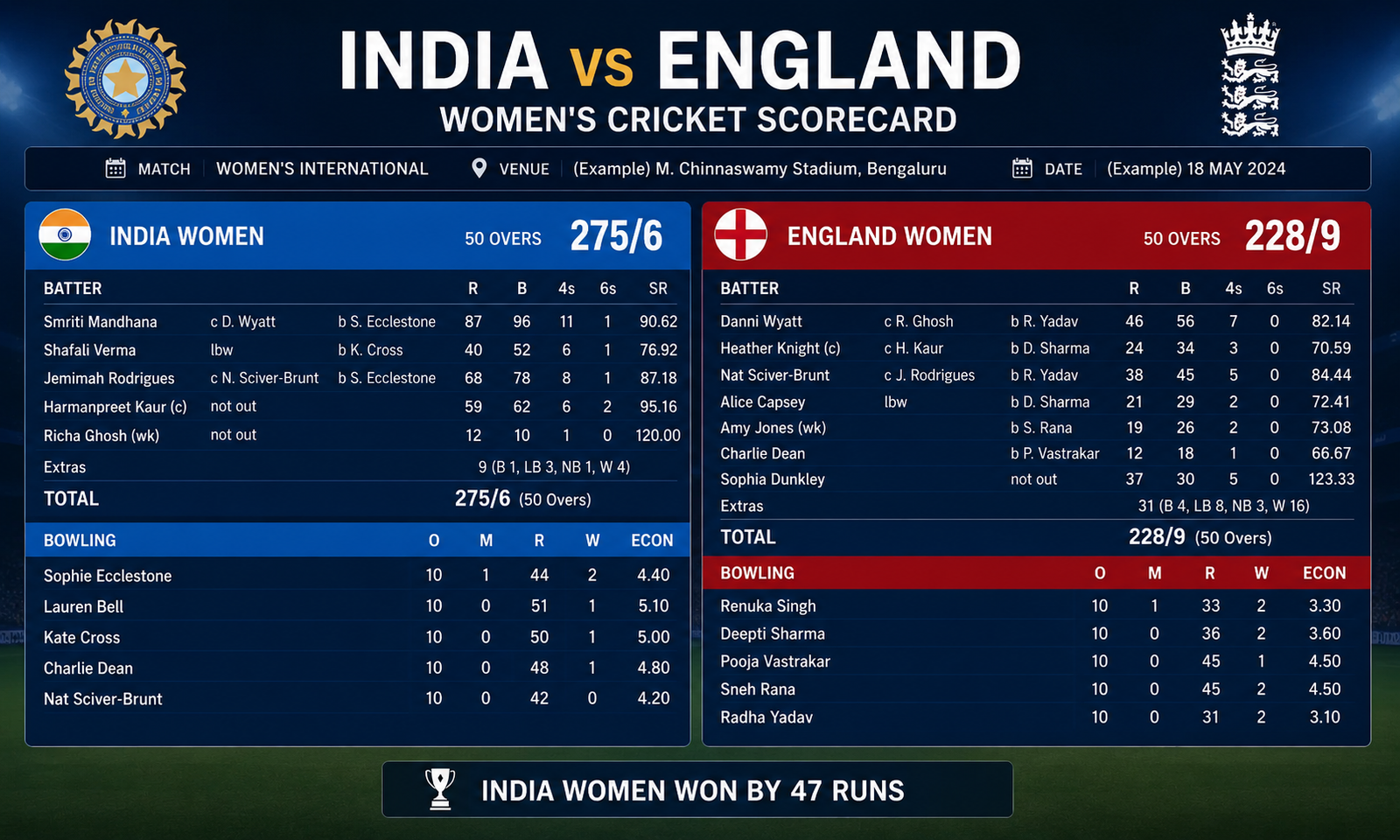
Cricket enthusiasts around the globe closely monitor the rivalry between the England Women’s National Cricket Team and the India Women’s National Cricket Team. Whenever these two powerhouse nations clash, the resulting match scorecard tells a story of tactical brilliance, athletic endurance, and shifting momentum. Analyzing a scorecard from this specific matchup requires looking beyond the basic runs and wickets to understand the underlying strategies.
Understanding the nuances of a cricket scorecard is essential for analyzing how a match unfolds. The scorecard records every single delivery, documenting the runs scored, wickets taken, extras conceded, and the overall run rate. When examining the encounters between the England Women’s National Cricket Team and the India Women’s National Cricket Team, the scorecard acts as a historical document that highlights the strengths and weaknesses of both squads.
In recent years, the India Women’s National Cricket Team has demonstrated remarkable growth in both limited-overs and Test cricket formats. Conversely, the England Women’s National Cricket Team has long maintained a reputation for disciplined bowling attacks and aggressive top-order batting. When these two distinct styles collide, the scorecard reflects a fascinating tug-of-war.
This post breaks down the critical components of the scorecard from their most notable recent Test encounter. We will examine the individual innings, highlight standout performances, and explain how the statistical data translates into real-world tactical advantages for future series.
Table of Contents
What were the key takeaways from the India vs England match?
To truly grasp the dynamics of the December 2023 Test match, we must analyze the progression of the scorecard across all four innings. The match took place at the DY Patil Stadium in Navi Mumbai, providing a pitch that initially favored batters before deteriorating to assist spin bowlers.
India Women’s National Cricket Team First Innings Dominance
The India Women’s National Cricket Team batted first, setting a monumental foundation. The scorecard shows India amassing a massive 428 runs in their first innings. Four different Indian batters scored half-centuries, demonstrating incredible depth in their batting lineup.
This phase of the scorecard highlights the importance of partnerships. Instead of relying on a single explosive century, the India Women’s National Cricket Team built consistent 50-plus run partnerships. For analysts reading the scorecard, this indicates a high level of rotational strike play and an ability to neutralize the England Women’s National Cricket Team’s pace attack. By keeping the English bowlers on the field for an extended period, the Indian batters induced physical fatigue, which paid dividends later in the match.
England Women’s National Cricket Team Struggle Against Spin
When the England Women’s National Cricket Team took to the crease, the scorecard painted a starkly different picture. England managed only 136 runs in their first innings. The bowling analysis section of the scorecard reveals exactly why: the Indian spinners dismantled the English batting order.
Deepti Sharma’s figures of 5 wickets for 7 runs (5/7) stand out as a historic bowling achievement. When looking at the fall of wickets (FOW) section on the scorecard, the collapse was rapid. England lost steady wickets without forming the necessary partnerships required in Test cricket. This statistical breakdown shows that the England Women’s National Cricket Team struggled significantly against the turning ball, a common challenge for touring teams playing on Indian pitches.
How did individual players perform in the match?
A match scorecard is ultimately a collection of individual performances that combine to dictate the final result. Several players from both the England Women’s National Cricket Team and the India Women’s National Cricket Team left indelible marks on the statistical record.
Standout Performances for Team India
Deepti Sharma dominated the scorecard in both disciplines. Her first-innings score of 67 runs helped propel India to their massive total. However, her bowling figures were the defining factor of the match. Across both innings, Sharma took a total of 9 wickets for 39 runs. The scorecard reflects her incredible accuracy; a high percentage of her deliveries were dot balls, creating immense pressure that forced the English batters into making fatal errors.
Additionally, Jemimah Rodrigues and Yastika Bhatia provided crucial middle-order stability. Their strike rates, prominently displayed on the batting scorecard, were unusually high for a Test match, indicating a proactive approach against the English bowlers.
Standout Performances for Team England
While the match heavily favored the home team, the England Women’s National Cricket Team scorecard still featured resilient individual efforts. Nat Sciver-Brunt emerged as the top scorer for England in the first innings, showcasing her trademark technique against spin bowling.
On the bowling front, Sophie Ecclestone and Lauren Bell put in grueling shifts. The bowling scorecard reveals that they bowled the bulk of the overs for the England Women’s National Cricket Team. While their economy rates were slightly higher than their career averages, their persistence on an unhelpful pitch demonstrated elite endurance.
Why does this match scorecard matter for future tournaments?
Analyzing the scorecard of the England Women’s National Cricket Team vs India Women’s National Cricket Team match provides critical data for upcoming World Cups and bilateral series.
First, the scorecard exposes the vulnerabilities of the English batting lineup against quality spin on subcontinental pitches. As upcoming global tournaments are frequently hosted in Asia, the England Women’s National Cricket Team coaching staff will use this data to adjust their training camps, focusing on playing spin with softer hands and utilizing the sweep shot more effectively.
Second, the scorecard reinforces the India Women’s National Cricket Team’s strategy of aggressive middle-order batting. By scoring quickly in the middle overs, India dictates the pace of the game. Future opponents will study this scorecard to devise field placements and bowling rotations specifically designed to contain players like Yastika Bhatia and Harmanpreet Kaur.
Where can fans find live scorecards for future matches?
Following the England Women’s National Cricket Team vs India Women’s National Cricket Team rivalry requires access to reliable, real-time data. Fans and analysts can track live scorecards through several platforms.
The official International Cricket Council (ICC) website and mobile application provide the most accurate, up-to-the-minute scorecards. These platforms offer granular data, including wagon wheels (showing where runs were scored on the field) and pitch maps (showing where the bowlers pitched the ball). Additionally, dedicated sports news outlets like ESPNcricinfo and Cricbuzz offer live commentary alongside their scorecards, providing essential context to the raw numbers. Choose the official ICC app if you want direct, ad-free statistics, but opt for ESPNcricinfo if expert analysis and historical context matter more to your viewing experience.
The Future of the India vs England Rivalry
The statistical footprint left by the England Women’s National Cricket Team and the India Women’s National Cricket Team guarantees that their future encounters will be heavily scrutinized. The 347-run victory for India in Navi Mumbai established a new benchmark for dominance in women’s Test cricket.
As both nations continue to invest heavily in their domestic structures—such as the Women’s Premier League (WPL) in India and The Hundred in England—the depth of talent will only increase. Future scorecards between these two sides will likely feature new names making historic impacts. By understanding how to read and interpret the scorecard, fans can deeply appreciate the strategic chess match unfolding on the cricket pitch.
Frequently Asked Questions
Who won the recent Test match between India and England women?
The India Women’s National Cricket Team won the December 2023 Test match against the England Women’s National Cricket Team by a historic margin of 347 runs.
Where was the India vs England women’s Test match played?
The match was played at the DY Patil Sports Academy Stadium in Navi Mumbai, India, from December 14 to December 16, 2023.
Who was the player of the match in the India vs England Test?
Deepti Sharma of the India Women’s National Cricket Team was named Player of the Match. She scored 67 runs in the first innings and took a total of 9 wickets across the match (5/7 in the first innings and 4/32 in the second).
What is a good score in a women’s Test cricket match?
A first-innings score of over 300 runs is generally considered a strong foundation in women’s Test cricket. The India Women’s National Cricket Team’s first-innings score of 428 against England is considered exceptionally high and heavily dictated the match outcome.
Where can I view the official scorecard for India vs England matches?
You can view official, detailed scorecards on the official ICC website, as well as on major cricket data platforms like ESPNcricinfo and Cricbuzz, which provide ball-by-ball updates and historical archives.

