

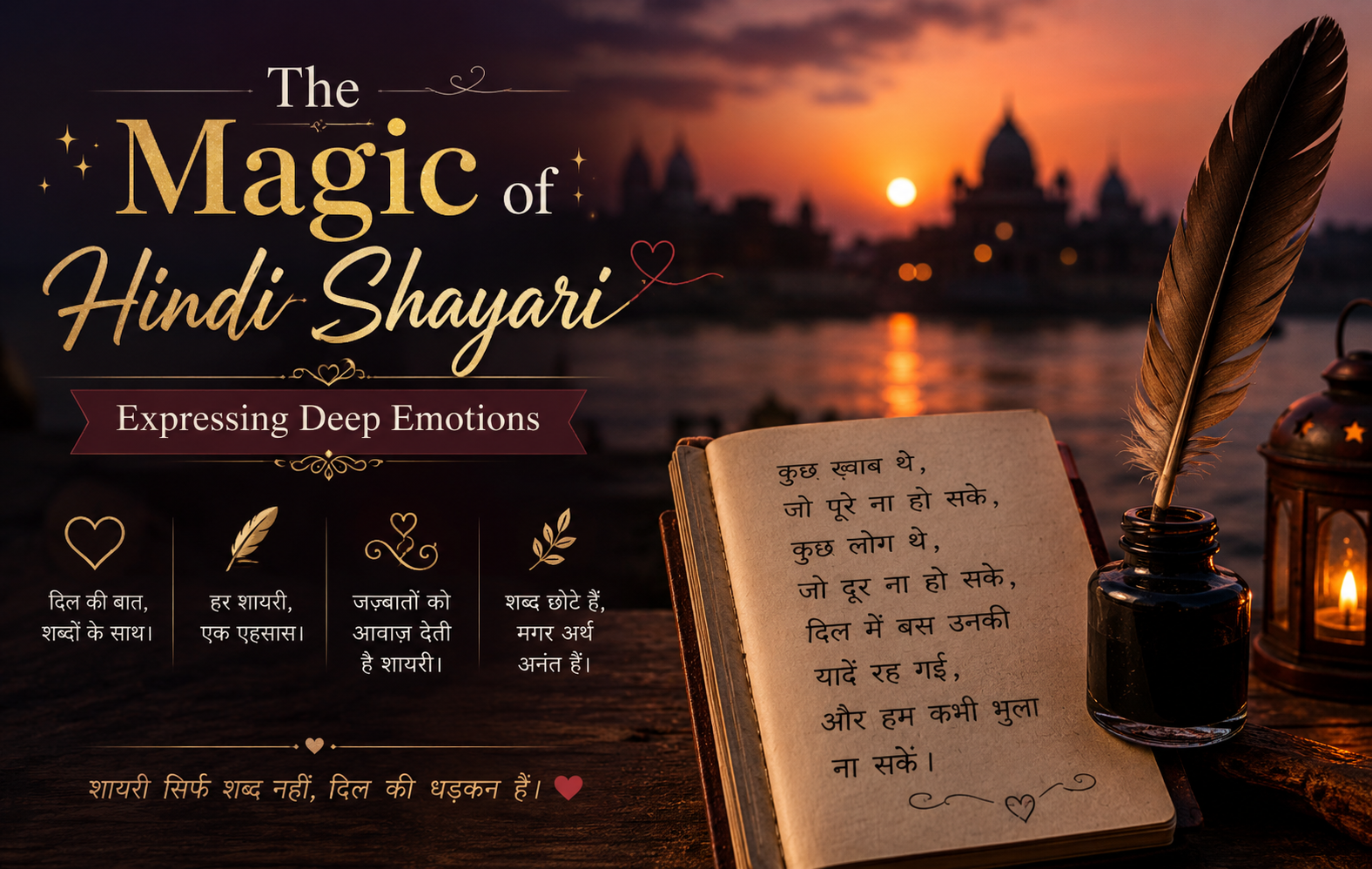
Words hold a unique power to heal, connect, and transform human experiences. Across the Indian subcontinent, one specific literary tradition has captured hearts for centuries. Hindi Shayari offers a profound way to articulate feelings that often seem too complex for regular conversation. It weaves together rhythm, raw emotion, and cultural richness into short, memorable verses.
At its core, Shayari is a form of poetry. People use it to celebrate love, mourn loss, and reflect on the unpredictable nature of life. A few carefully chosen words can instantly resonate with a crowd, bringing strangers together through a shared understanding of joy or sorrow. You hear it at grand poetry gatherings known as mushairas, read it in classic literature, and see it shared widely on modern social media feeds.
Understanding this poetic form opens up a completely new way to appreciate language. This guide explores the fascinating history of Hindi and Urdu poetry, the different styles of verses, and the legendary poets who shaped the craft. You will learn the hidden rules behind a beautifully constructed couplet and discover how to start appreciating or even writing your own poetry.
Table of Contents
The Rich History Behind Hindi and Urdu Poetry
The origins of Shayari trace back to Arabic and Persian literary traditions. As these cultures interacted with the Indian subcontinent over several centuries, their languages blended with local dialects. This fusion eventually gave birth to Urdu and Hindustani. Poets began writing in these new, melodic languages, finding them perfect for expressing deep, complex sentiments.
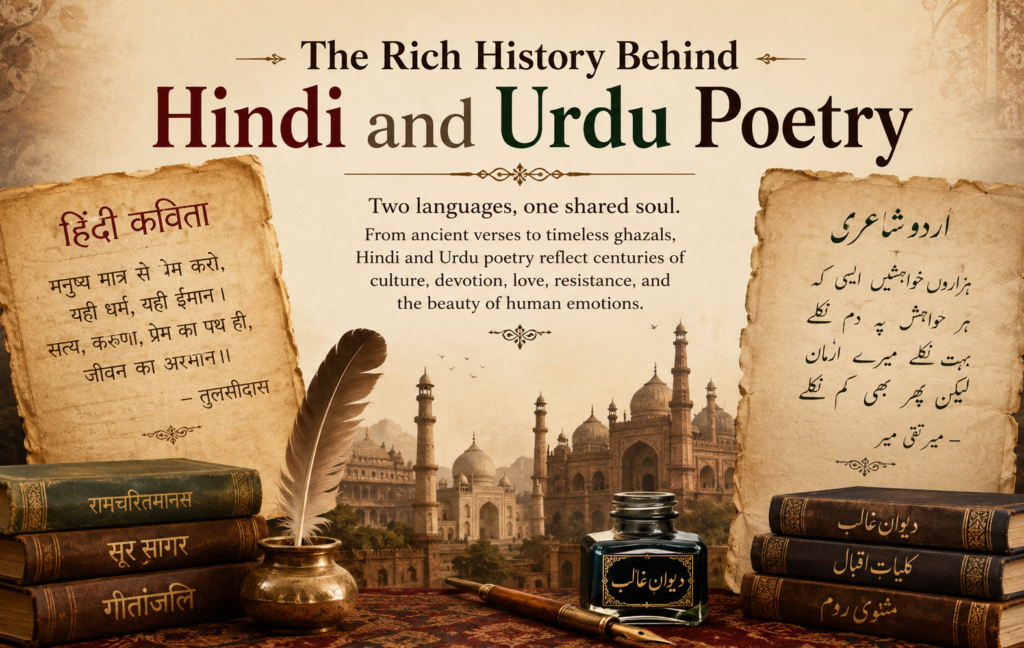
During the Mughal era, royal courts became the primary hubs for poetic innovation. Emperors and nobles sponsored poets, hosting lavish evenings where writers would recite their latest works. These gatherings allowed the art form to flourish. The language of Shayari is often a beautiful mix of Hindi and Urdu, making it accessible to a massive population while maintaining an elegant, sophisticated vocabulary.
Over time, this poetry moved out of the royal courts and into the streets. It became a voice for the common people. Freedom fighters used verses to inspire resistance during the Indian independence movement. Later, the Indian film industry heavily adopted these poetic styles, embedding soulful lyrics into the cultural fabric of the nation.
Understanding the Structure of Shayari
To truly appreciate Hindi Shayari, you need to understand how it is built. The beauty of this poetry lies in its strict yet highly creative structure.
The Sher (Couplet)
A “Sher” is a poem consisting of just two lines. Despite its brevity, a Sher must convey a complete thought or emotion. The first line sets up the premise or builds anticipation. The second line delivers the punchline, resolution, or profound truth. When people share short quotes on their messaging apps, they are usually sharing a single Sher.
The Ghazal
A Ghazal is a collection of couplets. These couplets share the same meter and a specific rhyming pattern. Interestingly, the individual couplets in a Ghazal do not have to follow a single narrative. One couplet might talk about romantic love, while the next discusses political turmoil or spiritual longing. The connecting thread is the structural rhyme and the overall mood of the piece.
The Nazm
Unlike a Ghazal, a Nazm is a poem dedicated to a single, continuous theme. It has a clear beginning, middle, and end. Modern poets often prefer the Nazm format when they want to tell a specific story or explore a single philosophical idea in great depth.
Popular Themes in Hindi Shayari
Human emotion is vast, but certain universal themes dominate this poetic landscape.
Ishq: The Language of Love
Love remains the most popular subject in Hindi Shayari. Poets describe every stage of romance, from the initial spark of attraction to the comfortable silence of long-term devotion. These verses often use nature metaphors—like the moon, the ocean, and blooming flowers—to describe the beauty of a beloved.
Dard: Finding Beauty in Heartbreak
Sorrow and separation have inspired some of the greatest poetry ever written. “Dard” translates to pain. Heartbreak poetry does not just dwell on sadness; it romanticizes the longing and the memories left behind. These verses provide immense comfort to people going through difficult times, reminding them that their pain is a universal human experience.
Zindagi: Philosophical Reflections on Life
Life is unpredictable, and Shayars love to observe its ironies. “Zindagi” (life) poetry tackles the passage of time, the pursuit of wealth, and the inevitability of death. These verses encourage readers to live in the moment and appreciate the fleeting nature of their existence.
Dosti: Celebrating Friendship
Friendship holds a sacred place in Indian culture. Poetry dedicated to “Dosti” celebrates loyalty, shared childhood memories, and the friends who stand by you when the rest of the world turns away. These couplets are incredibly popular among young people today.
Legendary Shayars You Should Know
You cannot explore this art form without acknowledging the masters who defined it. Their words remain as relevant today as the day they were written.
Mirza Ghalib
Operating in the 19th century, Mirza Ghalib is arguably the most famous poet in the Urdu and Hindi languages. His work is known for its intense philosophical depth and witty playfulness. Ghalib often questioned traditional norms and expressed a profound understanding of human suffering.
Rahat Indori
Moving to more contemporary times, Dr. Rahat Indori was a modern legend. He was famous for his powerful, booming voice and fearless poetry. He often addressed political corruption, social justice, and the struggles of the common man. His performances at live poetry events were electrifying, drawing massive, cheering crowds.
How to Appreciate and Write Your Own Verses
You do not need to be a linguistic expert to enjoy or create Shayari. Start by reading translations of classic poets. Pay attention to how they use a few words to paint a massive picture. Listen to spoken word performances online to hear the natural rhythm and pauses that bring the words to life.
If you want to write your own, focus on honesty. The best poetry comes from real, lived experiences. Do not worry too much about strict rhyming rules at first. Focus on the feeling you want to convey. Write down a thought, then try to trim away any unnecessary words until only the core emotion remains. Read it aloud to see if it carries a natural musicality.
Keep the Tradition Alive
Hindi Shayari is a living, breathing art form. It bridges the gap between the past and the present, offering a timeless vocabulary for our deepest emotions. By reading, sharing, and writing these verses, you participate in a rich cultural conversation that has lasted for centuries.
Take a moment today to find a Sher that resonates with your current mood. Share it with a friend, write it in a journal, or simply sit with the words and let their meaning wash over you. Explore the works of different poets, and you will soon find a voice that speaks directly to your soul.

