

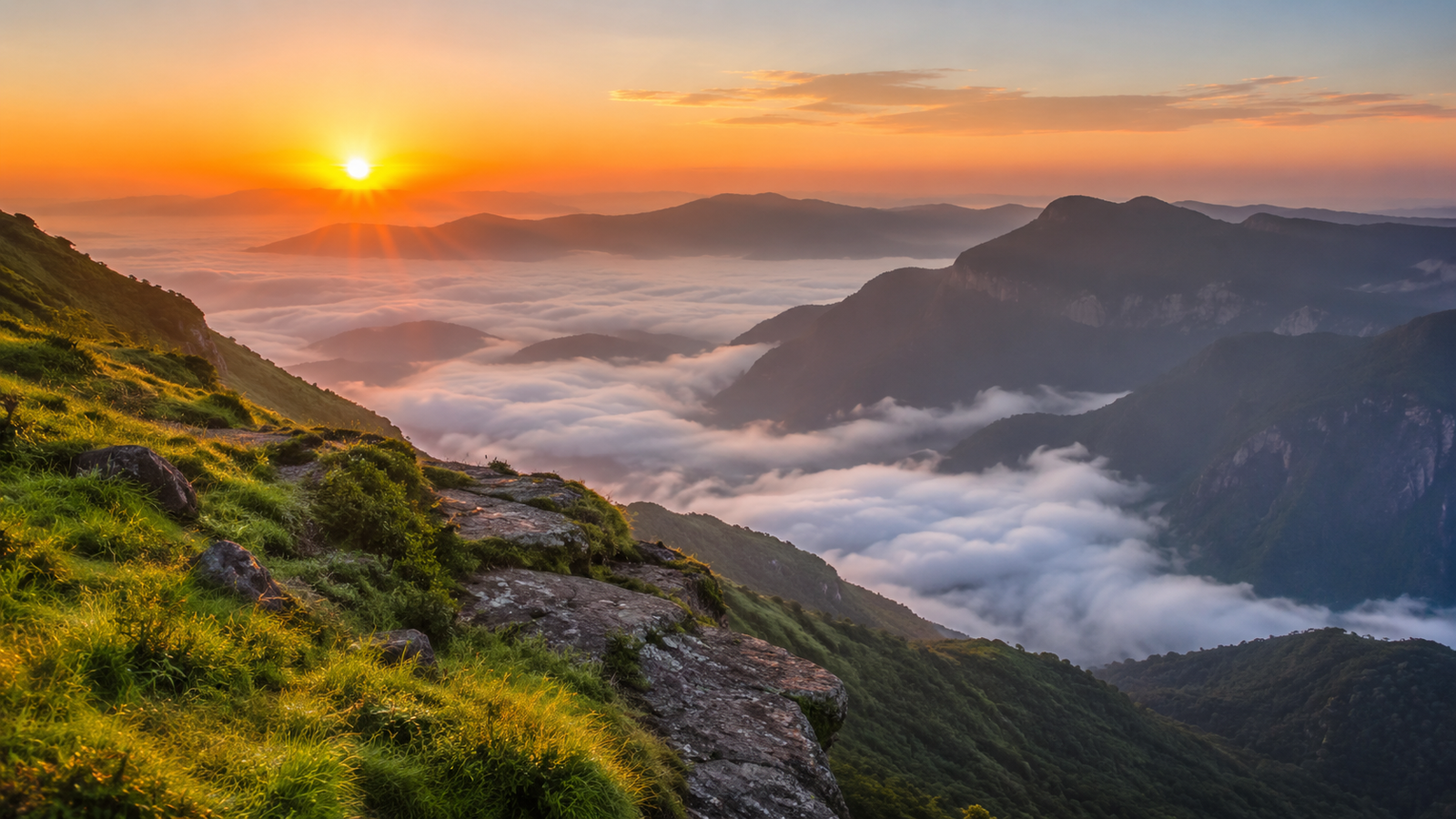
Meghalaya’s best sunrise points include Shillong Peak, Laitlum Canyons, Mawkdok Dympep Valley, Cherrapunji, and Dawki River. Each location offers dramatically different landscapes—from misty canyon ridges to glassy river reflections—making the northeastern Indian state one of the country’s most rewarding sunrise destinations.
Meghalaya, whose name translates to “Abode of Clouds” in Sanskrit, earns that title every single morning. Just before dawn, thick layers of mist roll across the Khasi Hills and cascade into the valleys below. Then the sun breaks the horizon—and everything turns gold.
This northeastern Indian state is one of the wettest places on Earth, yet that same weather system that drenches it in rain is responsible for some of the most dramatic morning skies you’ll find anywhere on the subcontinent. The low-hanging clouds, the dense pine forests, and the deep gorges create a stage that few other destinations can match.
Whether you’re a seasoned landscape photographer chasing that perfect golden-hour frame, or simply someone who wants to start a day with something genuinely breathtaking, Meghalaya delivers. The challenge isn’t finding a beautiful sunrise—it’s choosing which one to chase first.
This guide covers the best sunrise points in Meghalaya in 2026, including practical details on how to reach each spot, the best time to visit, and what makes each location distinct.
What Makes Meghalaya One of India’s Best Sunrise Destinations?
Before diving into specific locations, it’s worth understanding why Meghalaya stands apart from other sunrise destinations in India.
The state sits at an average elevation of around 1,000–1,900 meters above sea level. At this altitude, clouds behave differently. Rather than sitting high above, they move through valleys and across ridgelines at eye level—sometimes below you. This creates the phenomenon known locally as a “cloud sea,” where you watch the sunrise from above a blanket of white mist, as if the earth has been replaced with cotton.
Meghalaya also benefits from its position in the northeastern corner of India, closer to Myanmar and Bangladesh than to New Delhi. Sunrise here begins earlier than in most of mainland India, and the light quality—soft, diffused by moisture-laden air—is extraordinary for photography.
The state’s biodiversity adds another dimension. Sacred groves, living root bridges, and forested ridgelines mean every sunrise comes with a natural foreground. You’re not watching the sun rise over a flat horizon. You’re watching it rise over a landscape that took thousands of years to form.
Shillong Peak: The Most Accessible Sunrise Viewpoint in Meghalaya
Standing at 1,965 meters above sea level, Shillong Peak is the highest point in the Khasi Hills and the easiest major sunrise spot to access from the state capital, Shillong. The site is maintained by the Indian Air Force, which means the viewpoint is kept clean and accessible, though entry is subject to security checks.
On clear mornings—particularly between October and February—visitors standing at Shillong Peak can see three countries simultaneously: India, Bangladesh, and on exceptionally clear days, Bhutan. The sunrise here typically paints the sky in layers, from deep crimson near the horizon to pale amber directly overhead.
The drive from Shillong city center takes approximately 30–40 minutes. Most travelers and tour operators recommend arriving no later than 5:30 AM to secure parking and reach the viewpoint before the first light appears. Entry fees are nominal and collected at the base checkpoint. Check current timings and entry guidelines on the Meghalaya Tourism official website before planning your visit, as hours may vary by season.
Best time to visit Shillong Peak: October through February, when post-monsoon clarity makes for unobstructed views. Avoid the monsoon months (June–September) unless you specifically want moody, cloud-heavy conditions.
Laitlum Canyons: Where the Canyon Floor Disappears Below the Clouds
Located roughly 25 kilometers from Shillong, Laitlum Canyons—whose name means “end of the hills” in Khasi—offer one of the most dramatic canyon sunrise experiences in northeastern India. Unlike a single viewpoint, Laitlum is a series of ridgelines and grassy plateaus perched at the edge of a canyon that plunges hundreds of meters into the valley below.
What sets Laitlum apart at sunrise is the cloud inversion. During autumn and winter mornings, the canyon floor fills with mist while the ridgeline remains clear. As the sun rises, the mist glows orange and pink from within, creating a visual effect that looks almost surreal—as if the canyon is breathing light.
The terrain here is suitable for slow morning walks along the canyon rim. Local villagers often set up small stalls selling tea and local breakfast items by around 6:30 AM. The road to Laitlum from Shillong is winding and narrow in sections, so four-wheel drive vehicles or careful driving is advisable. Google Maps directions to Laitlum Canyons can help you navigate the final stretch, which is sometimes unmarked.
Best time to visit Laitlum Canyons: November through January for cloud inversions. Late September and early October also offer lush green post-monsoon landscapes.
Mawkdok Dympep Valley View Point: A Sunrise Above Cherrapunji’s Gateway
The Mawkdok Dympep Valley View Point sits along the road connecting Shillong to Cherrapunji (locally known as Sohra), approximately 27 kilometers from Shillong. At an elevation that looks directly down into one of the world’s deepest valleys, this spot is often the first major stop on any Cherrapunji road trip—but it deserves a dedicated sunrise visit of its own.
The valley here is wide, bowl-shaped, and almost always threaded with low clouds during early morning hours. Sunrise light enters from the east and catches the mist horizontally, turning the entire valley into a glowing amber basin for approximately 15–20 minutes before the clouds burn off.
There is also a zip line and suspension bridge at this viewpoint operated by a private operator, which gives adventurous travelers the option to combine their sunrise experience with an early-morning aerial crossing. Visit the Mawkdok Valley official tourism page for updated activity schedules in 2026.
Best time to visit Mawkdok Dympep Valley: October through February. Arrive by 5:15 AM for the clearest pre-dawn views.
Cherrapunji (Sohra): Sunrise at the Edge of One of the Wettest Places on Earth
Cherrapunji holds the record for the highest recorded monthly rainfall in world history—according to the India Meteorological Department, the town received 9,300 mm of rain in July 1861 alone. Yet outside of the monsoon season, Cherrapunji reveals a completely different personality: clear skies, dramatic cliff edges, and valleys so deep they create their own weather systems.
Several sunrise viewpoints surround Cherrapunji. Nohkalikai Falls viewpoint—where Asia’s tallest plunge waterfall drops 340 meters into a turquoise pool below—faces east, making it a natural sunrise platform. The Seven Sisters Falls viewpoint, approximately 4 kilometers from Cherrapunji town, also catches excellent early morning light.
Cherrapunji is located about 55 kilometers from Shillong and is best reached the evening before if you intend to catch sunrise without a 3 AM departure from the city. Several guesthouses and eco-resorts in the Sohra area offer early wake-up calls and packed breakfasts for sunrise-bound guests.
Best time to visit Cherrapunji for sunrise: October, November, and March through May offer the clearest conditions. December and January can be cold but beautifully clear.
Dawki River: A Sunrise Reflected on Crystal-Clear Water
Dawki is a different kind of sunrise destination. Located approximately 95 kilometers south of Shillong, near the Bangladesh border, Dawki is best known for the Umngot River—often called Asia’s cleanest river, where the water is so transparent that boats appear to float in mid-air.
At sunrise, the river’s mirror-like surface reflects the sky perfectly. The surrounding hills, still dark and forested, frame a canvas of pink and orange light doubled by the reflection below. For photographers, Dawki at sunrise is one of the most compositionally rich locations in all of Meghalaya.
Access requires an overnight stay in Dawki or the nearby town of Shella, as the drive from Shillong takes approximately 2.5 hours on mountain roads. Boat rides on the Umngot River begin early in the morning and can be arranged through local operators near the main ghat. Meghalaya Tourism’s Dawki page lists licensed boat operators and accommodation options.
Best time to visit Dawki: October through April. The river is clearest from November to March when rainfall has ceased and water flow is lower.
Mawsynram: The World’s Wettest Village and Its Misty Sunrise Reveal
Mawsynram, which holds the Guinness World Record for the highest average annual rainfall (approximately 11,871 mm per year, according to the World Meteorological Organization), is located about 60 kilometers from Shillong. Most travelers overlook it as a sunrise destination because of its reputation for constant rain—but that’s exactly what makes it extraordinary on dry mornings.
When the rain pauses, typically between late November and February, Mawsynram sits above a sea of dense mist that blankets the valleys below. The sunrise here is slow and layered—clouds peel back in stages, revealing green hills and distant plains as the temperature rises. The experience feels earned, which perhaps makes it more memorable.
Accommodation in Mawsynram is limited, so most visitors make the journey from Shillong in the early hours of the morning. The road has improved significantly following infrastructure development projects completed in 2024–2025.
Best time to visit Mawsynram: Late November through February for clear, post-monsoon sunrises.
Practical Tips for Chasing Sunrises Across Meghalaya in 2026
Timing your visit: The golden window for sunrise photography and clear skies across most of Meghalaya falls between October and February. During these months, rainfall is minimal and visibility is at its highest. Sunrise times in Meghalaya typically range from 5:20 AM in October to around 5:55 AM in January, due to the state’s northeastern position.
Transportation: Most sunrise spots require early departures, often between 3:30–5:00 AM depending on distance from Shillong. Renting a private vehicle is the most practical option. Several travel agencies in Shillong offer sunrise-specific tour packages that include transportation and a local guide. Meghalaya Tourism’s official travel partner directory lists registered operators.
Weather: Always check the weather forecast the evening before. Even in the dry season, cloud cover can roll in overnight and obscure views. Apps like Windy (windy.com) offer terrain-specific cloud cover forecasts that are particularly useful in hilly regions like Meghalaya.
Camera gear: A tripod is essential for pre-dawn photography. The light levels at 5:00 AM are extremely low, and even a slight shake will blur long-exposure shots. Wide-angle lenses work well for canyon and valley views, while a mid-range telephoto lens helps isolate cloud textures and distant ridgelines.
Respect local customs: Several sunrise viewpoints in Meghalaya are located near or within sacred groves (known as law kyntang in Khasi). These areas are protected by community law and carry cultural and spiritual significance. Visitors should observe posted guidelines, avoid littering, and follow any restrictions on photography within sacred areas.
Start Planning Your Meghalaya Sunrise Trip Now
Meghalaya’s sunrise experiences range from the easily accessible—Shillong Peak, 40 minutes from the city center—to the genuinely remote, like Mawsynram and Dawki, which reward travelers willing to put in the extra hours. Each location offers something distinct: canyon mist, river reflections, cloud seas, waterfall views, and record-breaking rainfall that transforms into clear, luminous mornings.
The best time to plan a Meghalaya sunrise itinerary is right now, before the peak travel season between October and February fills up guesthouses and popular viewpoints. Research accommodation near Cherrapunji or Dawki early, book a reliable vehicle, and give yourself at least four to five days to cover the major sunrise spots without rushing.
Meghalaya’s mornings have a way of staying with you long after you’ve returned home—not because they’re dramatic in a flashy sense, but because they’re quietly, persistently extraordinary.
Frequently Asked Questions About Sunrise Points in Meghalaya
What is the best time of year to see sunrises in Meghalaya?
October through February is the best period for clear sunrises across Meghalaya. Post-monsoon skies are cleaner, cloud inversions are more common in valleys, and temperatures are cooler. The monsoon season (June–September) brings heavy rain and reduced visibility, though misty, atmospheric sunrises are still possible for those who seek that aesthetic.
Which sunrise point in Meghalaya is best for first-time visitors?
Shillong Peak is the most accessible sunrise spot for first-time visitors. Located 30–40 minutes from Shillong city, it requires no overnight stay and offers panoramic views at 1,965 meters elevation. Laitlum Canyons is a close second for those willing to drive an extra 25 kilometers from the city.
How far in advance should I plan a sunrise trip to Meghalaya?
For travel between October and February—Meghalaya’s peak season—booking accommodation and transport at least four to six weeks in advance is recommended. Popular spots like Cherrapunji and Dawki fill up quickly. For off-peak travel (March–May), two to three weeks’ notice is generally sufficient.
Is it safe to drive to sunrise viewpoints in Meghalaya before dawn?
Most major sunrise points—Shillong Peak, Laitlum, Mawkdok—are accessible on paved roads that are safe to navigate before dawn with a reliable vehicle and a local driver familiar with the route. Remote locations like Mawsynram and Dawki involve narrower mountain roads and are best tackled with a four-wheel drive vehicle and local guidance.
Can I visit multiple sunrise points during a single trip to Meghalaya?
Yes. A five- to seven-day itinerary from Shillong allows for visits to Shillong Peak, Laitlum Canyons, Mawkdok, Cherrapunji, Mawsynram, and Dawki, with one sunrise location per morning. Many travelers combine a Cherrapunji sunrise with daytime visits to the living root bridges, then move south to Dawki for the final day.

