

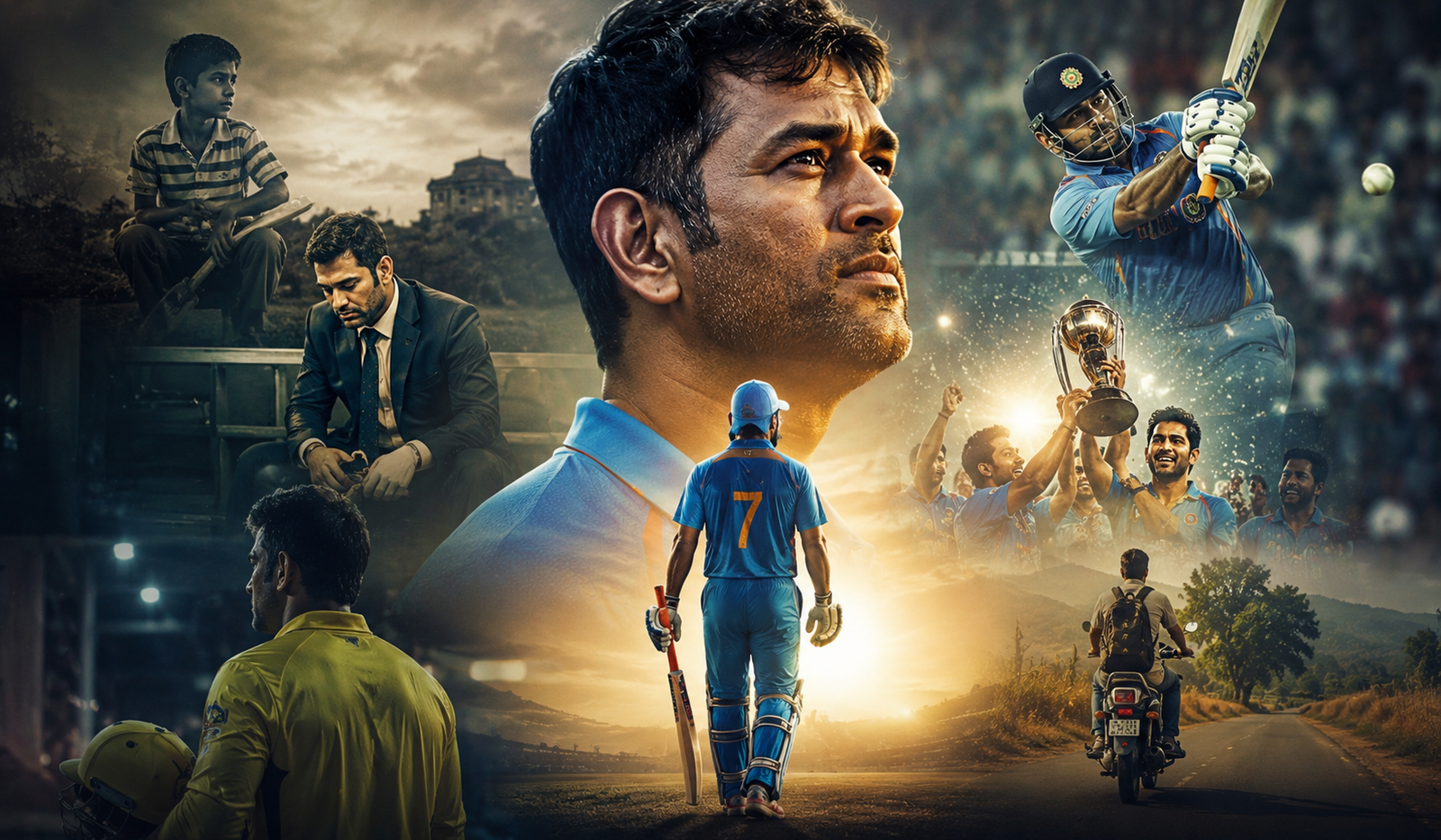
MS Dhoni The Untold Story Behind India’s Legendary Captain
MS Dhoni is a former Indian cricketer widely regarded as one of the greatest captains in cricket history. Born on July 7, 1981, in Ranchi, India, Dhoni led India to three ICC tournament victories—the 2007 T20 World Cup, 2011 ODI World Cup, and 2013 Champions Trophy—and remains one of the most decorated players the sport has ever seen.
Few athletes transcend their sport the way Mahendra Singh Dhoni has. He wasn’t just a wicketkeeper-batsman. He was a symbol—of calm under pressure, of unorthodox success, and of what’s possible when raw talent meets extraordinary mental fortitude.
Dhoni’s story doesn’t begin in a stadium. It begins in Ranchi, a mid-sized city in Jharkhand, where a young boy who had never been given a red-carpet welcome into professional cricket built a career that would end with the entire nation weeping at his retirement. His journey from a ticket collector at Kharagpur railway station to a World Cup-winning captain is one of the most compelling origin stories in sports history.
This blog post traces Dhoni’s life in full—his early years, his meteoric rise, his most memorable achievements, his leadership philosophy, and the lasting legacy he leaves behind. Whether you’re a cricket enthusiast or a newcomer to the sport, Dhoni’s story offers lessons that stretch far beyond the boundary rope.
Where Was MS Dhoni Born and What Were His Early Years Like?
Mahendra Singh Dhoni was born on July 7, 1981, in Ranchi, Jharkhand (then part of Bihar), to Pan Singh and Devaki Devi. His father worked in junior management positions with MECON, and the family lived a modest, grounded life. From an early age, Dhoni showed a passion for sports—but football, not cricket, was his first love. He played as a goalkeeper for his school team and was reportedly so impressive that his football coach encouraged him to try his hand at cricket.
That small nudge changed the course of cricket history.
Dhoni joined his school cricket team at Shyamali, and his wicketkeeping skills caught everyone’s attention immediately. He was selected to play for the Commando Cricket Club and later for the Bihar U-16 team. Even in those formative years, teammates and coaches noticed something different about him—he rarely panicked, he read the game with unusual clarity, and he could hit the ball harder than anyone else his age.
How Did MS Dhoni Begin His Professional Cricket Career?
Before the world knew his name, Dhoni was working as a Travelling Ticket Examiner (TTE) at Kharagpur railway station between 2001 and 2003. He balanced the job with cricket, which was still more of a passion than a guaranteed career path. This chapter of his life is often highlighted as a reminder that success, for Dhoni, was never handed to him.
His breakthrough in professional cricket came through the Ranji Trophy with Bihar (later Jharkhand), where his aggressive batting and sharp wicketkeeping drew serious attention. He was selected for India A tours before eventually earning his first senior international call-up.
Dhoni made his ODI debut for India on December 23, 2004, against Bangladesh in Chittagong. The match wasn’t memorable for him—he was run out for zero. But the selectors saw enough to keep faith, and just two games later, he announced himself to the world with a stunning 148 against Pakistan in Vishakapatnam. That innings, played with fearless aggression, signaled to everyone watching: this was no ordinary cricketer.
What Made MS Dhoni Such an Exceptional Batsman and Wicketkeeper?
Dhoni’s batting style defied conventional cricket wisdom. He batted at number seven for much of his career—and yet accumulated over 17,000 international runs across all formats. His trademark “helicopter shot,” a high-torque finish played against the turn, became one of the most replicated strokes in cricket, a shot so distinctive it’s now named after him.
Behind the stumps, he was equally exceptional. Dhoni’s lightning-fast stumping reflexes, often completed in fractions of a second, set a standard that remains a benchmark for wicketkeepers globally. According to ESPNcricinfo, Dhoni has the record for most stumpings in ODI history—123—a number that speaks to his relentless precision and focus over two decades of international cricket.
Beyond the statistics, what set Dhoni apart was his ability to perform when it mattered most. He was a finisher—someone who could absorb pressure that would paralyze most players, and then release it in the form of sixes over long-on.
Why Is MS Dhoni Considered the Greatest Captain in Indian Cricket History?
Leadership is where Dhoni’s legacy becomes truly irreplaceable. He captained India in 332 international matches, winning 178 of them—a record that reflects both longevity and consistency at the highest level.
Under his captaincy, India achieved things that had seemed out of reach for generations. In 2007, Dhoni led a largely inexperienced Indian side to victory in the inaugural ICC T20 World Cup in South Africa, defeating Pakistan in a nail-biting final. It was a tournament that transformed the global landscape of T20 cricket and launched the era of the Indian Premier League.
The pinnacle came in 2011. On April 2, India faced Sri Lanka in the ICC ODI World Cup final at the Wankhede Stadium in Mumbai. India needed 275 runs. Dhoni promoted himself ahead of in-form batsmen and walked out at number five. He finished the match with an unbeaten 91 and a six over long-on that sent over a billion people into euphoria. It was a moment of calculated courage. As Wisden described it at the time, the six that won the World Cup was “the most significant shot in Indian cricket history.”
In 2013, India claimed the ICC Champions Trophy under Dhoni’s leadership, making him the only captain in ICC history to have won all three major white-ball trophies. He also led India to the top of the ICC Test rankings in 2009—a feat that underscored his ability to lead across all three formats.
What defined his captainship wasn’t just the wins. It was the manner of them. Dhoni was famously unrattled on the field. He earned the nickname “Captain Cool” because of his almost eerie composure in tense situations—a quality that rubbed off on his players and became a hallmark of the teams he led.
How Did MS Dhoni Approach Leadership and Decision-Making on the Field?
Students of leadership study Dhoni for reasons that go beyond cricket. His decision-making process was instinctive yet deeply analytical. He trusted data, but he also trusted his gut—and he was rarely wrong about either.
Perhaps the most striking aspect of his captaincy was how he handled young bowlers. Dhoni had a way of making debutants feel trusted and protected. He gave them difficult overs, backed their instincts, and shielded them from public criticism when things went wrong. Players like Ravindra Jadeja, Bhuvneshwar Kumar, and Jasprit Bumrah have all credited Dhoni’s mentorship as instrumental to their development.
He was also a master of field placement. Former players and commentators frequently point to his ability to read a batsman’s weakness and adjust the field before the bowler even had to ask. Dhoni saw the game several moves ahead—a quality usually associated with chess grandmasters, not cricketers.
You can read more about his leadership philosophy in this detailed piece by The Guardian.
What Was MS Dhoni’s Role in the Indian Premier League?
Dhoni’s impact on the Indian Premier League (IPL) is as significant as anything he achieved in international cricket. As the captain of Chennai Super Kings (CSK), Dhoni led the franchise to five IPL titles (2010, 2011, 2018, 2021, and 2023), making CSK one of the most decorated and beloved franchises in the tournament’s history.
His relationship with Chennai and the CSK fanbase transcends sport. The yellow jersey, the roar of the crowd at Chepauk—Dhoni became synonymous with the city even though he was born hundreds of kilometers away. Fans called him “Thala,” a Tamil word meaning “leader,” and the devotion they showed him was extraordinary.
Even in the later stages of his IPL career, when his batting had slowed slightly, Dhoni remained invaluable as a captain, a mentor, and a match-reader. The 2023 IPL title—the last he captained CSK to—was perhaps his most emotionally significant, arriving 12 years after their first.
For a comprehensive overview of CSK’s IPL history, BCCI’s official website offers detailed records and statistics.
When Did MS Dhoni Retire and How Did the World React?
Dhoni announced his retirement from international cricket on August 15, 2020—India’s Independence Day—with a characteristically understated Instagram post and a video montage set to the song “Main Pal Do Pal Ka Shair Hoon.” There was no press conference, no grand farewell match, no trophy presentation. Just a quiet goodbye from a man who had always let his cricket do the talking.
The reaction across India and the cricket world was immediate and emotional. Tributes poured in from teammates, opponents, fans, and heads of state alike. Prime Minister Narendra Modi called him “a brilliant captain who led India with exceptional skill.” Former Australian captain Ricky Ponting, speaking to Cricket Australia, said Dhoni was “the most complete limited-overs player he had ever seen.”
The grief was real because the appreciation was real. India had watched Dhoni grow from a long-haired boy from Ranchi into the most decorated captain in Indian cricket history. His retirement marked the end of an era.
What Is MS Dhoni’s Lasting Legacy in World Cricket?
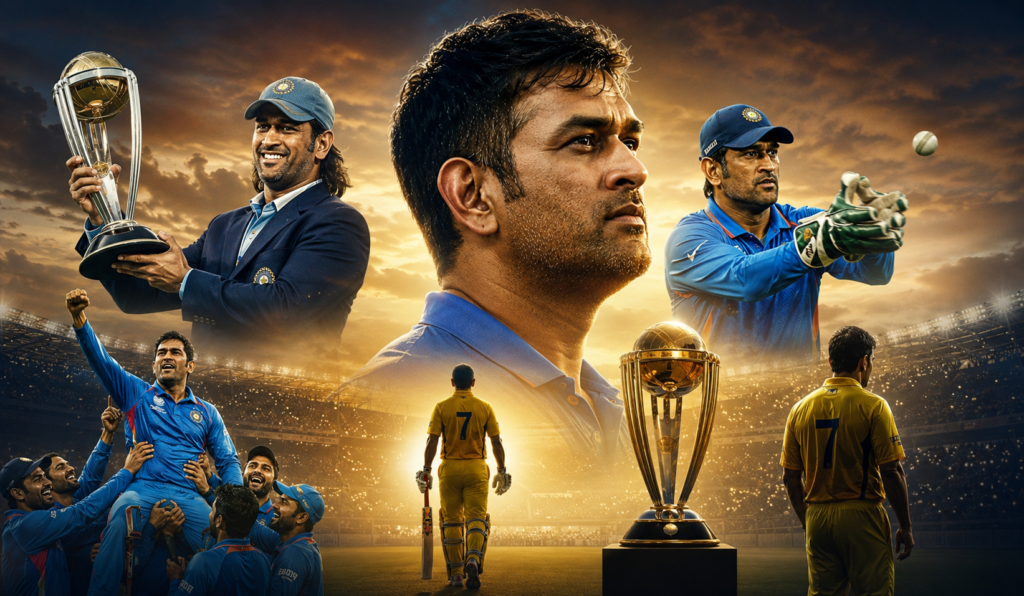
Dhoni’s legacy is woven into the fabric of modern cricket. He helped professionalize the sport in India at a time when it was transitioning from a beloved pastime to a multibillion-dollar global industry. He shaped an entire generation of Indian cricketers who credit him as a mentor and role model.
His records are staggering: over 17,000 international runs, 829 international dismissals as a wicketkeeper, three ICC trophies as captain, and five IPL titles. But numbers capture only part of the story. The bigger part lives in the culture he created—one built on fearlessness, humility, and the belief that staying calm is itself a form of strength.
Statues have been erected in his honor. Films have been made about his life—most notably the 2016 biopic MS Dhoni: The Untold Story, starring Sushant Singh Rajput—which introduced his journey to audiences who had never followed cricket. His face remains one of the most recognized in India, and his commercial appeal has endured years beyond his international retirement.
What Can We Learn From MS Dhoni’s Life and Career?
Dhoni’s story is ultimately about resilience and self-belief. He came from no cricketing dynasty. He had no privileged access to elite coaching academies or big-city infrastructure. What he had was work ethic, an unbreakable temperament, and an intuitive understanding of the game.
He proved that the quality of your mind matters as much as the quality of your technique—that staying composed when everyone else is panicking is, in itself, a superpower.
For young cricketers, aspiring leaders, and anyone who has ever felt like an outsider looking in, Dhoni’s career offers an enduring lesson: back yourself, stay calm, and finish what you start.
Frequently Asked Questions About MS Dhoni
What is MS Dhoni’s full name?
MS Dhoni’s full name is Mahendra Singh Dhoni. He was born on July 7, 1981, in Ranchi, Jharkhand, India.
How many ICC trophies has MS Dhoni won as captain?
MS Dhoni has won three ICC trophies as India’s captain: the 2007 ICC T20 World Cup, the 2011 ICC ODI World Cup, and the 2013 ICC Champions Trophy. This makes him the only captain in cricket history to have won all three major ICC white-ball tournaments.
What is the helicopter shot in cricket, and who invented it?
The helicopter shot is a batting technique where the batsman scoops the ball with a high-speed wrist roll at the point of contact, typically used against yorkers or full deliveries. MS Dhoni popularized the shot and is widely credited for inventing it, though he has credited Santosh Lal, a local cricketer from Ranchi, with originally showing it to him.
Why is MS Dhoni called Captain Cool?
MS Dhoni earned the nickname “Captain Cool” because of his remarkable composure under pressure. He rarely showed visible emotion on the field—whether India was winning comfortably or facing a collapse—and his calm demeanor had a stabilizing effect on his teammates during high-pressure matches.
What is MS Dhoni doing after his retirement from international cricket?
After retiring from international cricket in August 2020, MS Dhoni has continued to play in the Indian Premier League (IPL) for Chennai Super Kings. He also stays active with business ventures and philanthropy, and remains one of the most commercially influential figures in Indian sport.

