

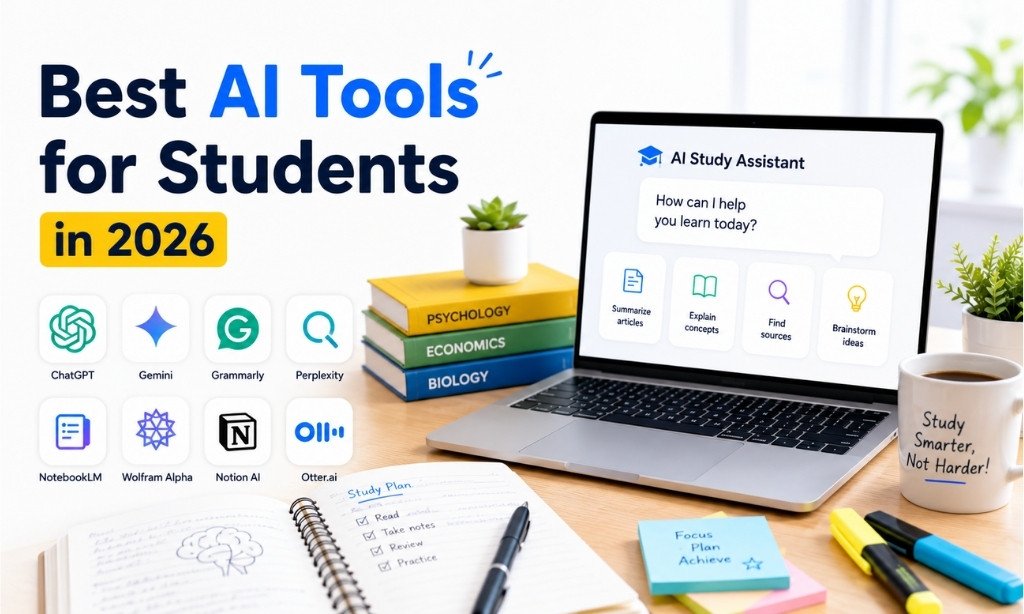
In 2026, the academic landscape has shifted. AI is no longer just a novelty—it is a foundational component of modern education. With almost every student now leveraging these tools, the focus has moved from simple adoption to AI agency: the art of using technology to augment your own intellect rather than bypassing the essential work of learning.
College remains as relentless as ever. Between back-to-back lectures, mounting deadlines, and the pressure to maintain a balanced life, finding time for deep, meaningful study can feel impossible. That’s why the best AI tools for students have become essential academic companions. When used correctly, these tools act as a 24/7 tutor, research assistant, and productivity coach, helping students learn more efficiently without sacrificing genuine understanding.
This guide cuts through the noise of the 2026 market, organized by what you are trying to accomplish, to help you build a smarter, more efficient study stack.
Table of Contents
What makes an AI tool worth using in 2026?
A genuinely useful AI tool for students today should do at least one of the following exceptionally well:
- Remove administrative friction: Handling formatting, transcribing, or organizing so you can focus on the content.
- Deepen conceptual grasp: Acting as a “Socratic” tutor that explains complex ideas in plain language.
- Synthesize large volumes of data: Helping you find the signal in the noise of heavy reading lists.
- Enhance output quality: Providing sophisticated feedback on your writing, logic, and structure.
The Best AI Tools for Writing and Editing
ChatGPT & Gemini — The versatile study companions
By 2026, both platforms have evolved into interactive tutors. ChatGPT remains the leader for nuanced reasoning and brainstorming complex ideas, while Google Gemini is now deeply integrated into the Google Workspace, allowing it to pull context directly from your Google Docs or Drive.
- Best for: Brainstorming structures, debugging code, and explaining dense academic concepts.
- Watch out for: “Hallucinations.” Always treat the AI as a collaborator whose work must be fact-checked, never as a primary source.
Grammarly & QuillBot — Beyond spellcheck
These tools have moved well beyond basic grammar. They now offer advanced tone analysis, citation generation (APA/MLA/Chicago), and sophisticated paraphrasing that helps clarify your voice without losing your unique perspective.
- Best for: Refining academic tone, ensuring clarity, and managing complex citation requirements.
- Watch out for: Over-reliance. Use them to learn why a sentence is clunky rather than just clicking “accept” on every suggestion.
The Best AI Tools for Research and Studying
Perplexity AI — The research engine
Perplexity has become the standard for academic research. Unlike standard chatbots, it functions like a hyper-efficient search engine, providing synthesized answers that are strictly tied to traceable, cited sources.
- Best for: Mapping out a new topic and finding credible, linked sources for papers.
- Watch out for: While sources are cited, they still need to be verified against your institution’s library databases for deep academic rigor.
NotebookLM (Google) — The personal knowledge base
The breakout tool of 2026. You upload your specific PDFs, lecture transcripts, and notes, and the AI builds a private, “grounded” knowledge base. It will only answer questions based on the files you gave it.
- Best for: Summarizing massive textbooks, cross-referencing multiple lectures, and preparing for finals.
Wolfram Alpha — The STEM powerhouse
Still the undisputed king of computation. While LLMs are great for prose, Wolfram Alpha is a computational engine. It doesn’t “guess” the answer; it calculates it. Its step-by-step walkthroughs are essential for mastering math, physics, and engineering.
- Best for: Quantitative problem-solving, unit conversions, and complex graphing.
The Best AI Tools for Productivity and Organization
Notion AI — The “second brain”
Notion continues to be the best way to centralize your life. Its AI features allow you to summarize messy meeting notes, draft assignments, and manage project deadlines within a unified workspace.
- Best for: Students who need a single command center for their academic and personal lives.
Otter.ai — The lecture assistant
Otter.ai has refined its ability to transcribe lectures in real-time, providing an automated summary of key takeaways and action items. This is a game-changer for those who find it difficult to capture every detail while listening.
- Best for: Students with large lecture loads or those who process information better through reading than listening.
Navigating Academic Integrity in 2026
Universities have largely moved past the “prohibition phase.” Most institutions now expect you to use AI, but the burden of responsibility has shifted to transparency.
- Process vs. Product: Using AI to generate an entire essay (the “product”) is academic misconduct. Using AI to help you outline, brainstorm, or clarify an argument (the “process”) is considered modern scholarship.
- The Disclosure Expectation: Many professors now require an AI Disclosure Statement. Always state clearly if you used AI to help brainstorm or proofread.
- The “Productive Friction” Test: If an assignment feels too easy because of AI, you aren’t learning. The goal is to use AI to remove the administrative “busy work” so you can spend more time on the hard, deep work of actual analysis.
Building Your 2026 Workflow
Don’t try to use everything at once. Build your stack based on your specific bottlenecks:
- Drowning in readings? Use NotebookLM to create summaries from your PDFs.
- Stuck on a draft? Use ChatGPT to critique your argument structure.
- Math/Science heavy? Rely on Wolfram Alpha for the mechanics.
- Lecture overload? Use Otter.ai to transcribe and Notion to store your organized notes.
Start with the free tiers of these tools. In 2026, the free versions are incredibly powerful, and you should only consider a paid “Pro” subscription once you are certain that a specific tool is fundamentally changing your productivity for the better.
Students, marketers, and entrepreneurs can benefit from the insights shared in this analysis of the best AI content generator in 2026.

