

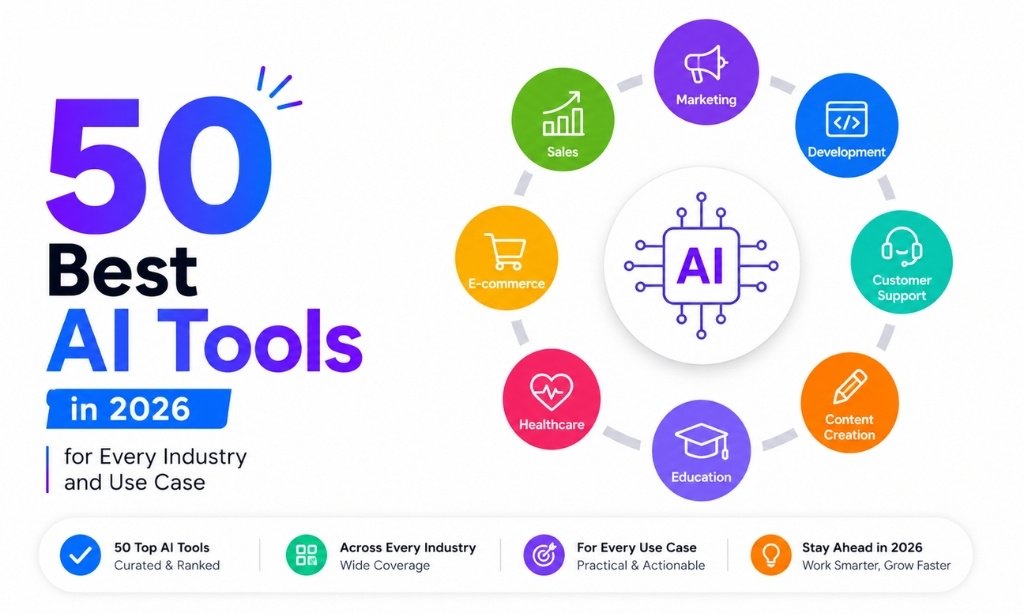
The best AI tools in 2026 span writing, image generation, video creation, coding, productivity, and more. Top picks include ChatGPT, Claude, Gemini, Jasper, Midjourney, and GitHub Copilot. The right tool depends on your use case, budget, and technical skill level.
AI tools have moved well past the novelty stage. By 2026, they’re embedded into daily workflows across virtually every industry—from solo creators and freelancers to Fortune 500 teams. The challenge is no longer finding an AI tool. It’s knowing which ones are worth your time.
This post cuts through the noise. Below, you’ll find 50 of the best AI tools available in 2026, organized by category, with a clear breakdown of what each tool does and who it’s best for. Whether you’re looking to accelerate content creation, sharpen your code, automate repetitive tasks, or produce stunning visuals, there’s something here for you.
Each tool on this list was selected based on capability, ease of use, value for money, and relevance in 2026’s AI landscape.
Table of Contents
Best AI Writing and Content Tools
Writing is where AI made its earliest and most dramatic impact—and the category keeps improving. These tools help with everything from blog posts and ad copy to long-form research and email drafting.
1. ChatGPT (OpenAI)
Best for: General-purpose writing, research, and conversation
ChatGPT remains one of the most versatile AI tools available. OpenAI’s GPT-4o model powers fast, accurate responses across an enormous range of tasks. The tool’s ability to maintain context over long conversations makes it especially useful for complex, iterative writing projects.
2. Claude (Anthropic)
Best for: Long-form writing and nuanced reasoning
Claude 3.5 and its successors consistently outperform competitors on tasks requiring careful reasoning and longer context windows. Anthropic’s focus on safety and accuracy makes Claude a strong choice for research-heavy content.
3. Gemini (Google DeepMind)
Best for: Multimodal tasks and Google Workspace integration
Gemini integrates directly with Google Docs, Gmail, and Sheets, making it highly practical for teams already embedded in the Google ecosystem. Its ability to process text, images, and data simultaneously gives it a strong edge for mixed-media projects.
4. Jasper
Best for: Marketing teams and brand content at scale
Jasper is purpose-built for marketing. It offers pre-built templates for ads, blog posts, email campaigns, and social media, all trained to produce on-brand output. Jasper’s Brand Voice feature allows teams to define and maintain consistent tone across every asset.
5. Copy.ai
Best for: Sales copy and go-to-market content
Copy.ai focuses on pipeline-oriented content—outreach emails, product descriptions, and conversion-focused landing pages. Its workflow automation tools make it a practical choice for sales and growth teams.
6. Writesonic
Best for: SEO-focused blog content
Writesonic integrates with real-time search data to produce blog posts informed by current rankings and keyword gaps. It’s a practical tool for content marketers trying to improve organic visibility.
7. Grammarly
Best for: Editing, proofreading, and tone adjustment
Grammarly has expanded well beyond grammar checks. Its 2026 version includes AI-assisted rewriting, tone detection, and goal-setting features that help writers match their content to a specific audience.
8. Notion AI
Best for: Note-taking, project documentation, and internal wikis
Notion AI helps teams draft, summarize, and organize knowledge directly within Notion workspaces. It reduces the friction between capturing ideas and turning them into structured documents.
9. Sudowrite
Best for: Fiction writers and novelists
Sudowrite is one of the few AI writing tools designed specifically for creative fiction. Its features—including story brainstorming, chapter expansion, and character development—cater to writers working on long-form narrative projects.
10. Rytr
Best for: Budget-conscious writers and freelancers
Rytr offers a generous free tier and covers a wide range of content formats. It’s not the most powerful tool on this list, but for individuals producing moderate volumes of short-form content, it delivers solid value.
Best AI Image Generation Tools
11. Midjourney
Best for: High-quality artistic and commercial image generation
Midjourney consistently produces some of the most visually striking AI-generated images available. Its v6 model delivers exceptional detail, coherence, and stylistic range—making it the preferred tool for designers, marketers, and creative directors.
12. DALL·E 3 (OpenAI)
Best for: Prompt-accurate image generation integrated with ChatGPT
DALL·E 3 excels at following precise textual descriptions, making it useful when accuracy matters more than artistic flair. Its ChatGPT integration makes it highly accessible for non-designers.
13. Adobe Firefly
Best for: Enterprise design and Creative Cloud users
Adobe Firefly is trained on licensed content, making it safer for commercial use. Its tight integration with Photoshop, Illustrator, and other Adobe tools means professional designers can incorporate AI generation without leaving their existing workflow.
14. Stable Diffusion (Stability AI)
Best for: Developers and power users wanting full control
Stable Diffusion remains the most customizable open-source image model available. Teams willing to invest in fine-tuning can produce highly specific, brand-consistent outputs that closed-source tools can’t replicate.
15. Ideogram
Best for: Images with legible text
Ideogram stands out in one specific area: generating images that include readable text. This makes it uniquely useful for creating mock-ups, social graphics, and promotional materials.
Best AI Video Tools
16. Runway (Gen-3 Alpha)
Best for: AI video generation and editing for creatives
Runway’s Gen-3 Alpha model produces high-fidelity video clips from text prompts and reference images. Its editing suite also allows frame-level manipulation, making it a comprehensive production tool.
17. Sora (OpenAI)
Best for: Cinematic text-to-video generation
Sora produces long, coherent video sequences from text descriptions—a significant step beyond earlier tools. Access has expanded significantly since its initial release, and it now supports a wider range of creative and commercial applications.
18. HeyGen
Best for: AI avatar videos and video localization
HeyGen allows users to create realistic talking-head videos using AI avatars and voice cloning. Its translation feature can automatically dub videos into multiple languages while keeping the speaker’s lip movements in sync.
19. Synthesia
Best for: Corporate training and internal communication videos
Synthesia specializes in professional AI presenter videos—no camera, no studio required. It’s widely used for onboarding, compliance training, and product demos.
20. Descript
Best for: Podcast and video editing by transcript
Descript treats video and audio editing like text editing. Cut a word from the transcript, and the corresponding clip disappears. It’s one of the most intuitive tools available for creators without a traditional editing background.

Best AI Coding Tools
21. GitHub Copilot
Best for: In-editor code completion and generation
GitHub Copilot remains the industry standard for AI-assisted coding. Integrated directly into VS Code, JetBrains, and other IDEs, Copilot suggests complete functions, explains code, and identifies bugs in real time.
22. Cursor
Best for: AI-native code editing
Cursor is an IDE built around AI collaboration from the ground up. Unlike Copilot, which is layered on top of existing editors, Cursor allows developers to have full conversations about their codebase and make multi-file edits through natural language.
23. Replit AI
Best for: Beginners, students, and rapid prototyping
Replit combines a cloud-based coding environment with an AI assistant that can build, explain, and debug code alongside users. It removes the setup friction that often discourages newer developers.
24. Tabnine
Best for: Privacy-conscious teams and enterprise coding environments
Tabnine offers on-premises deployment, making it suitable for teams that cannot send proprietary code to third-party servers. It supports a wide range of programming languages and integrates with most major IDEs.
25. Amazon CodeWhisperer
Best for: AWS developers and cloud engineers
Amazon CodeWhisperer is optimized for AWS environments. It suggests code patterns aligned with AWS services and performs security scans to flag potential vulnerabilities before deployment.
Best AI Productivity and Automation Tools
26. Zapier AI
Best for: Workflow automation without coding
Zapier’s AI features allow users to describe a workflow in plain language and have it automatically built. For business teams managing repetitive, cross-platform tasks, this dramatically reduces setup time.
27. Make (formerly Integromat)
Best for: Complex, multi-step automation workflows
Make offers more granular control than Zapier, making it the preferred choice for operations teams building sophisticated, conditional workflows across many platforms.
28. Reclaim AI
Best for: Calendar management and time blocking
Reclaim AI analyzes a user’s tasks and priorities, then automatically schedules focused work sessions, meetings, and breaks. It protects deep work time without requiring constant manual calendar adjustments.
29. Otter.ai
Best for: Meeting transcription and summarization
Otter.ai transcribes meetings in real time, identifies speakers, and generates summaries with key action items. It integrates with Zoom, Google Meet, and Microsoft Teams.
30. Motion
Best for: Task management and intelligent scheduling
Motion combines a task manager with an AI scheduler that automatically prioritizes and time-blocks work based on deadlines and availability. It’s particularly well-suited for individuals managing high task volumes.
Best AI Research and Knowledge Tools
31. Perplexity AI
Best for: Real-time research and cited answers
Perplexity AI searches the web and returns answers with inline citations, making it far more verifiable than standard AI chatbots. It’s become a preferred research tool for professionals who need to fact-check on the fly.
32. Elicit
Best for: Academic research and literature review
Elicit uses AI to extract key findings from research papers, summarize studies, and identify relevant literature. Researchers and analysts use it to cut hours from systematic review processes.
33. Consensus
Best for: Evidence-based answers from peer-reviewed research
Consensus queries a database of scientific papers and surfaces findings with clear attribution. It’s designed for people who need answers grounded in published research, not general AI synthesis.
34. Scite
Best for: Evaluating how research is cited and contested
Scite tracks how scientific claims have been supported or challenged by subsequent papers. This nuanced view of scientific consensus is especially useful for researchers working in evolving or contested fields.
Best AI Customer Service Tools
35. Intercom Fin
Best for: Automated customer support for SaaS products
Intercom Fin is an AI agent trained on a company’s documentation and knowledge base. It handles the majority of support tickets autonomously, escalating to human agents only when necessary.
36. Zendesk AI
Best for: Enterprise customer service teams
Zendesk’s AI features include intelligent triage, automated responses, and agent-assist tools that surface relevant knowledge base articles during live conversations. It scales effectively for high-volume support environments.
37. Tidio
Best for: Small and medium e-commerce businesses
Tidio combines live chat with an AI chatbot that handles common product and order queries automatically. Its affordable pricing and ease of setup make it accessible for smaller teams.
Best AI Design and Creative Tools
38. Canva AI
Best for: Non-designers creating professional visuals
Canva’s suite of AI features—including Magic Design, text-to-image, and background removal—makes professional-looking design accessible without technical expertise.
39. Figma AI
Best for: UX/UI designers speeding up prototyping
Figma AI helps designers auto-generate layout variations, suggest design tokens, and prototype user flows faster. It’s embedded directly into the Figma workspace, minimizing context switching.
40. Looka
Best for: AI-generated branding and logo design
Looka generates logos, brand kits, and business cards based on user inputs about their industry, style preferences, and color palette. It’s a fast, cost-effective option for startups building their visual identity.
Best AI Sales and Marketing Tools
41. HubSpot AI
Best for: Inbound marketing and CRM-integrated content
HubSpot’s AI tools span content creation, email personalization, lead scoring, and predictive analytics—all within a unified CRM platform. Teams already using HubSpot gain the most from this integration.
42. Apollo AI
Best for: Outbound sales prospecting
Apollo uses AI to identify high-fit leads, personalize outreach sequences, and score prospects based on intent signals. It’s widely used by SDR teams looking to increase qualified pipeline.
43. Lavender
Best for: Sales email optimization
Lavender analyzes sales emails in real time and scores them based on factors correlated with high reply rates. It’s a focused, practical tool for any team relying on cold outreach.
44. Seventh Sense
Best for: Email send-time optimization
Seventh Sense analyzes recipient behavior to determine the optimal time to send each individual email. Marketers using HubSpot or Marketo can deploy it to meaningfully improve open rates.
Best AI Voice and Audio Tools
45. ElevenLabs
Best for: Realistic AI voice generation and cloning
ElevenLabs produces some of the most natural-sounding AI voices available in 2026. It supports voice cloning, multilingual dubbing, and long-form narration—used widely by podcasters, audiobook creators, and content studios.
46. Descript Overdub
Best for: Editing recorded speech using AI voice cloning
Overdub, part of Descript’s platform, allows creators to fix audio recordings by typing corrections rather than re-recording. It’s a significant time-saver for podcast and video producers.
47. Murf AI
Best for: Voiceovers for presentations and explainer videos
Murf offers a library of high-quality AI voices suitable for corporate training, e-learning content, and marketing videos. Its straightforward interface makes it accessible for non-technical users.
Best AI Data and Analytics Tools
48. Julius AI
Best for: Conversational data analysis
Julius AI allows users to upload spreadsheets and datasets, then ask questions in plain English to generate charts, summaries, and insights. It eliminates the need for SQL or Python skills for basic analytical tasks.
49. Obviously AI
Best for: Predictive analytics without a data science team
Obviously AI enables business users to build predictive models from their own data without writing code. Common use cases include churn prediction, revenue forecasting, and lead scoring.
50. Tableau with Einstein AI
Best for: Enterprise data visualization and AI-powered insights
Tableau’s Einstein AI layer adds natural language querying, automated insight generation, and anomaly detection to one of the world’s most established data visualization platforms.
How to Choose the Right AI Tool in 2026
With 50 strong options on the table, the real question is fit. A few decision criteria worth considering:
- Choose ChatGPT or Claude if you need a general-purpose AI assistant capable of handling a wide range of tasks with minimal setup.
- Choose Jasper or Writesonic if your primary need is high-volume, brand-consistent marketing content.
- Choose GitHub Copilot or Cursor if your team writes code daily and wants AI embedded directly in the development environment.
- Choose Midjourney or Adobe Firefly depending on whether artistic quality or commercial licensing is your priority.
- Choose Perplexity AI or Elicit if research accuracy and source attribution matter more than creative output.
The tools that deliver the most value are rarely the most powerful ones—they’re the ones that integrate most naturally into your existing workflow.
Frequently Asked Questions
What are the best AI tools for beginners in 2026?
ChatGPT, Canva AI, and Otter.ai are among the most beginner-friendly AI tools available in 2026. Each offers an intuitive interface, requires no technical setup, and covers high-value use cases like writing assistance, design, and meeting transcription.
What is the best AI writing tool in 2026?
ChatGPT and Claude are the most capable general-purpose AI writing tools in 2026. For marketing-specific content at scale, Jasper offers more tailored features, including brand voice customization and pre-built templates for ads, emails, and blog posts.
Are there free AI tools available in 2026?
Yes. Many top AI tools offer free tiers, including ChatGPT (free access to GPT-4o with limits), Grammarly (free grammar and tone features), Canva AI (free design tools), and Otter.ai (free meeting transcription up to a monthly limit). Paid plans unlock higher usage limits and advanced features.
How do I know which AI tool is right for my business?
Start by identifying your most time-consuming, repeatable tasks. Then match those tasks to a category—writing, design, coding, data analysis, and so on. Choose a tool within that category based on budget, integration with your existing software stack, and ease of adoption for your team.
What is the best AI tool for coding in 2026?
GitHub Copilot is the most widely adopted AI coding tool in 2026, with deep IDE integration and strong performance across multiple programming languages. Cursor is a strong alternative for development teams that prefer an AI-native editing environment with conversational coding features.
Will AI tools replace human workers?
The current evidence suggests AI tools augment rather than replace skilled workers in most fields. According to McKinsey’s 2024 research, AI automation is more likely to shift the nature of tasks within a role than to eliminate the role outright. Tools like Jasper, GitHub Copilot, and Runway accelerate output, but still require human judgment for strategy, quality control, and creative direction.

