

Building a technology company from the ground up requires more than just a brilliant idea. Many aspiring founders assume that a clever app or a new software platform will automatically attract paying customers. The reality of entrepreneurship involves careful planning, relentless execution, and a deep understanding of market dynamics.
Learning how to start a tech business means navigating a complex landscape of product development, funding, and marketing. You must balance technical requirements with solid business fundamentals. Failing to respect this balance is why many early-stage startups struggle to find their footing in competitive markets.
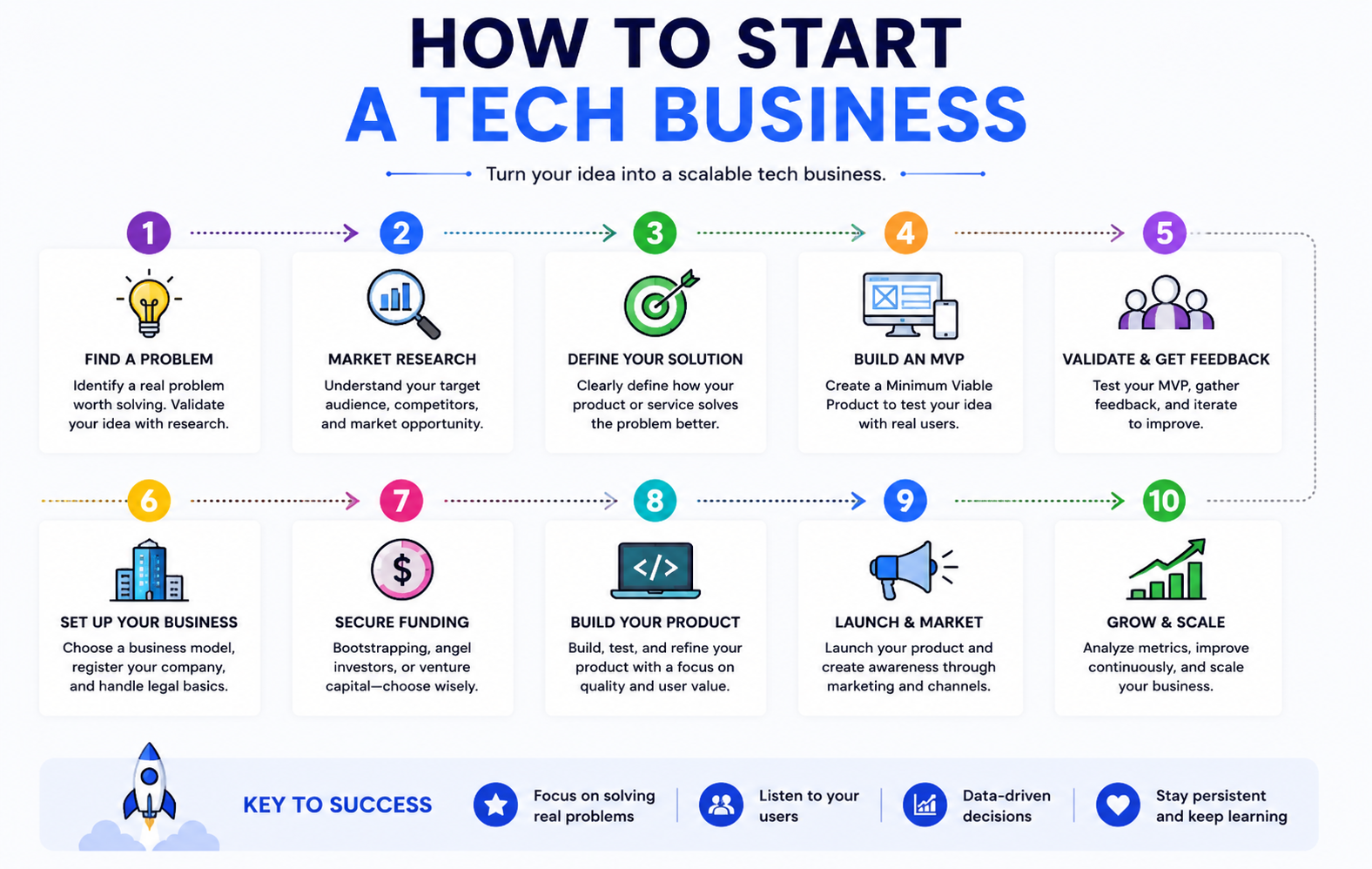
This guide breaks down the essential steps required to launch a successful tech company. You will learn how to validate your initial concept, build a minimum viable product, and secure the funding needed for sustainable growth. By following this blueprint, you can avoid common pitfalls and set a strong foundation for your future enterprise.
Identify a Solvable Problem
Every successful tech startup begins with a specific problem. Consumers and businesses buy software to remove friction from their daily lives. If your product does not address a genuine pain point, you will struggle to gain traction.
Look for market inefficiencies
Pay attention to the workflows and routines around you. When people complain about manual processes, clunky software, or wasted time, they are highlighting potential business opportunities. The best tech companies often emerge from a founder’s personal frustration with an existing system. Write down these frustrations and explore how technology might provide a faster, cheaper, or more reliable solution.
Validate your concept early
Do not spend months writing code before talking to potential users. You must confirm that your identified problem is actually worth solving. Reach out to people in your target demographic. Ask them about their current challenges and listen closely to their answers. If they show genuine enthusiasm for a potential solution, you have a solid starting point. If they seem indifferent, you may need to pivot your concept before investing further resources.
Conduct Thorough Market Research
Understanding your industry is a non-negotiable step. You need a clear picture of who will buy your product and who you are competing against.
Analyze your competitors
Identify the companies currently operating in your space. Study their pricing models, marketing strategies, and customer reviews. Look for gaps in their offerings. Perhaps they ignore a specific niche audience, or their user interface is notoriously difficult to navigate. You can use these weaknesses to position your tech business as a superior alternative.
Define your target audience
You cannot sell your product to everyone. Narrow down your focus to a specific group of early adopters. Create detailed buyer personas that outline their age, occupation, income level, and primary motivations. Knowing exactly who you are building for allows you to tailor your product features and marketing messages directly to their needs.
Build a Minimum Viable Product (MVP)
An MVP is the simplest version of your product that still delivers value to the user. The goal is to get a functional tool into the market as quickly as possible.
Focus on core features
Resist the urge to build a massive, complex platform right away. Identify the one specific feature that solves your user’s primary problem. Strip away everything else. A streamlined, highly functional tool is far more effective than a bloated application full of bugs. You can always add secondary features later.
Gather and implement user feedback
Once your MVP is live, treat user feedback as your most valuable asset. Monitor how people interact with your software. Ask for their honest opinions through surveys or direct interviews. Use this data to guide your product roadmap. Iterating based on real-world usage ensures you are building something people actually want to use and pay for.
Secure the Right Funding
Building software requires capital. You have to decide how you will finance your early operations and long-term growth.
Bootstrapping vs. external capital
Bootstrapping means funding the business yourself or using early revenue to cover expenses. This approach allows you to retain full control of your company. However, it can limit your growth speed. Alternatively, seeking external capital gives you the cash needed to scale quickly. You must decide which path aligns with your risk tolerance and business goals.
Pitching to investors
If you choose to raise money, you will need a compelling pitch. Angel investors and venture capitalists want to see a clear path to profitability. Prepare a solid business plan that highlights your market research, user acquisition strategy, and financial projections. Be ready to explain exactly how their capital will be used to generate a return on investment.
Assemble a Strong Team
A tech business is only as strong as the people building it. You need a team that covers both technical execution and business strategy.
Balance technical and business skills
If you are a talented software engineer, you might need a co-founder who excels at sales and marketing. If your background is in business, you need a reliable technical lead to manage product development. Finding partners whose skills complement your own is critical for long-term stability.
Prioritize company culture
The early employees you hire will set the tone for your entire organization. Look for individuals who are adaptable, resilient, and passionate about your mission. A cohesive team that communicates well can navigate the inevitable challenges of startup life much better than a group of disconnected individuals.
Plan Your Go-to-Market Strategy
Having a great product is useless if nobody knows it exists. Your go-to-market strategy dictates how you will acquire your first paying customers.
Digital marketing essentials
Leverage content marketing, search engine optimization, and social media to build brand awareness. Create valuable articles and videos that address your target audience’s problems. As you provide helpful information, you build trust and establish your brand as an authority in your industry.
Sales and distribution
Determine the most effective channels for selling your software. Will you rely on a self-serve subscription model on your website? Or do you need a dedicated sales team to close enterprise deals? Your sales strategy must align with your pricing model and the specific needs of your target market.
FAQ: Starting a Tech Business
Do I need to know how to code to start a tech business?
No. Many successful tech founders have zero programming experience. You can hire freelance developers, partner with a technical co-founder, or use no-code development platforms to build your initial product.
How much money do I need to launch a tech startup?
The cost varies wildly depending on your product. A simple mobile app can be built and launched for a few thousand dollars using low-cost tools and outsourced talent. A complex enterprise software platform may require hundreds of thousands of dollars in initial development and testing.
How long does it take to become profitable?
Most tech businesses take months or even years to turn a profit. Early revenue is typically reinvested directly back into product development and marketing to fuel further growth.
Take the First Step Toward Your Tech Empire
Starting a tech company is a demanding but incredibly rewarding process. By identifying a real problem, conducting thorough research, and launching an MVP, you minimize your risks and maximize your chances of success. Stay focused on your users, adapt to their feedback, and continue refining your product. The technology sector rewards those who execute with precision and persistence. Start outlining your business plan today, and take that crucial first step toward launching your venture.

